The Food and Drug Administration (FDA) of the Maharashtra government has made it mandatory for all hotels, restaurants, dhabas, canteens and food outlets to provide free and safe drinking water to the customers. It has been clearly stated that no customer can be forced to buy bottled water. This decision is being considered a big step towards strengthening food security and consumer rights. However, in India too, under FSSAI and consumer protection rules, it is considered necessary to provide safe drinking water to the customers. Let us know what the new order says and what are the rules for drinking water in India. We will also know what options the customer has if a restaurant refuses to provide water.
Maharashtra Food and Drug Administration has issued a new comprehensive food safety order for all hotels, restaurants, dhabas, canteens, cafeterias, bakeries, food courts, juice bars, catering units, chain restaurants and online food traders in the state. According to the order, every establishment will have to provide free and safe drinking water to the customers and will also have to put up a notice giving information about it.
Under the new order of Maharashtra FDA, now not only free drinking water, but many rules related to food safety have also been made strict. Now serving food in newspaper will not be allowed in any hotel, restaurant or food outlet. It will be mandatory to use only food grade packaging material for food so that there is no chemical pollution. Apart from this, it will also be necessary to conduct regular health checkups of the employees and provide them Food Safety and Certification Training (FOSTAC). Repeated use of oil used for cooking has also been banned.
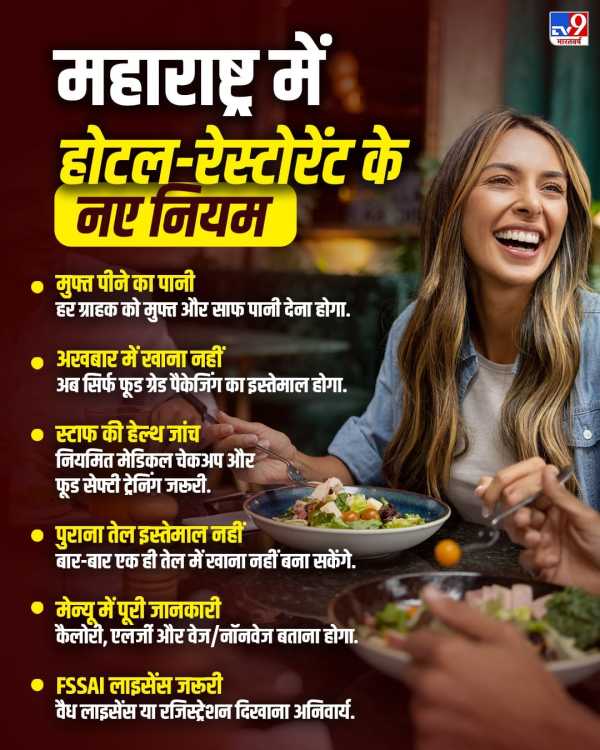
Under the new rules, big hotels, restaurants and food chains will now have to clearly write the calories of each dish, allergy related information and whether it is veg or non-veg in their menu. According to the FDA, in recent inspections, serious deficiencies were found in many places like cooking food in unhygienic conditions, use of poor packaging, negligence in temperature control and cooking food by employees without medical fitness. In view of these shortcomings, instructions have been issued for strict monitoring, regular investigation and action against those breaking the rules across the state.
In India, the Food Safety and Standards Authority of India (FSSAI) and rules related to consumer protection clearly state that it is necessary to provide safe drinking water to the customers. If a restaurant refuses to provide free water and pressures a customer to purchase bottled water, this may be considered unfair business practice. Many consumer commissions and courts have also clearly stated that access to clean drinking water is a basic right of the consumer. The main job of a restaurant is to provide food, not to forcefully sell packaged water to customers. Therefore, it is considered necessary to provide the option of safe RO water.
If a hotel or restaurant refuses to provide free drinking water or insists on buying only bottled water, the customer can first lodge a protest by informing them about their rights. After this, the bill should be kept safely and if needed, photos, videos or other evidence can also be kept safe. Complaints can be made on National Consumer Helpline 1915, Consumer Helpline Portal, Food Safety Connect Portal of FSSAI or Helpdesk 1800-11-2100. In serious cases, a complaint can be filed with the District Consumer Commission on the basis of deficiency in service and demand for compensation can also be made.
The biggest reason behind this is considered to be business profit. Restaurants earn additional income from the sale of bottled water. This is the reason why at many places packaged water is served directly to customers and the option of free water is not given. Some establishments cite cleanliness and claim that bottled water is safer. However, as per the rules, if the restaurant can provide safe and clean RO or filtered water, then it will have to provide the same to the customers for free.
With increasing awareness regarding consumer rights, complaints regarding such matters are also continuously coming to the fore. Of the total complaints received on the National Consumer Helpline, about 10 to 15 percent are related to the restaurant and hospitality sector. Among these, issues like forced sale of packaged water and service charges remain prominent. In many cases, District Consumer Commissions have given decisions in favor of customers and ordered restaurants to return bills and even pay compensation. Courts have also said that providing safe drinking water to customers is an essential part of service.