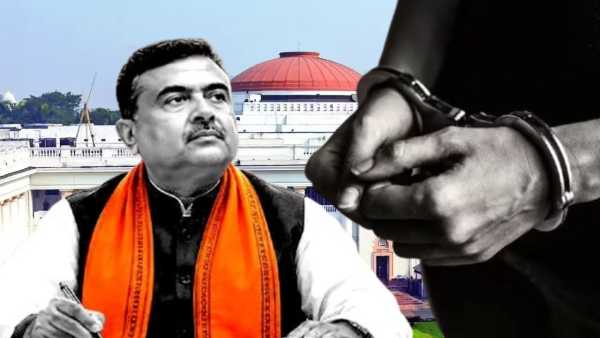
Subhendu Adhikari's government of West Bengal is bringing 'The West Bengal Public Safety and Control of Anti-Social Activists Bill, 2026' in the Assembly on Monday to rein in the goons. Apart from this, 'The West Bengal Maintenance of Public Order (Amendment) Bill, 2026' will be introduced to change the old law of the Congress era.
Earlier, Chief Minister speaking in the Assembly Shubhendu Adhikari Had said, "No thief will be spared. We have sworn that no thief will be left out of jail. Many people think that after going to jail, I am out on bail for 2 months. This will not happen. I am bringing a bill. I will also seize the property. I will auction it." Chief Minister Shubhendu has the Home Department. The Home Department will present a bill in the Assembly on Monday to rein in the goons.
The Home Department says that the purpose of this bill is to maintain public safety. Peace and order have to be maintained. Preventive detention against those whom the government considers 'anti-social' or 'goons' to prevent and control anti-social activities. Order to leave the area, power to search and seize, etc.
The Bill defines anti-social activity as any act which directly or indirectly-
Bill Gunda has been described as a person who, Either himself or as a member or leader of a group/gang/syndicate, regularly commits, attempts to commit, instigates, funds or facilitates anti-social activities; or is accused of committing an offense under section 111 or 112 of the Indian Penal Code (IPC); or he is involved in any offense under the Arms Act, NDPS Act, Immoral Traffic Act, Explosive Substance Act; Or known as a dangerous and desperate person in the society.
One of the most important parts of the bill is the power to arrest. If the State Government, on the basis of the report of a police officer of the rank of Superintendent of Police or above, feels that it is necessary to arrest a goon so that he is not able to carry out anti-social activities in future, then it can order his arrest.
District Magistrate or Police Commissioner can also issue detention order-
If the situation in any area is such that immediate action is required, then the government can, through notification, give the District Magistrate or Police Commissioner the authority to issue a detention order.
However, such order of detention will be immediately communicated to the state government. It will not be applicable for more than 15 days, unless the state government approves it within that time.
Detention order can be imposed anywhere in the state- When an order of detention is issued under this Act, it can be enforced anywhere in the state, just like an arrest warrant is enforced.
Where will the detainee be kept?
The detainee will be kept in the correctional facility in West Bengal decided by the government.
What will happen if he runs away?
What should the detained person be told?
The government cannot provide any information if it believes that providing the information would reveal the identity of a confidential source or would be against public order, public safety, internal security or national security. The second part is that the detained person should be given an opportunity to consult a lawyer and should be given proper assistance in getting representation.
Under this Act, the state government will form one or more advisory boards. The board will have a chairperson who will be a High Court judge or a former High Court judge. There will be two more members who will be eligible to become High Court judges.
What is its function?
Any person who is detained will be sent to this board within 3 weeks.
What will the board do?
It will check the documents. If necessary, it will ask for more information. If the detained person wishes, he can give him a chance to express his views. It will give its opinion to the government within 9 weeks whether there are sufficient grounds for detention.
If the board feels that there are sufficient grounds, the government can take him into custody. If the board finds that there are insufficient grounds, the government will cancel the detention order and release him. The detained person is not normally entitled to appear before the Board accompanied by a lawyer. However, the board can give permission in special cases if it wishes. Under this Act, detention can be for a maximum of 12 months. New detention can be done after the previous detention. The government can cancel or change the custody at any time.
But if the custody order is removed or the time expires, a fresh custody order can be issued again against the same person-
Temporary release-
If the government wishes, the detained person can be temporarily released for up to a week with or without conditions.
(a) Order to leave the area-
(b) To keep an eye on comings and goings-
Appeal facility-
Punishment for giving shelter-
Whoever knows or has reason to believe that an order of detention or deportation has been issued against any person under this Act, and yet harbors or conceals him. In that case, as a harborer, he could face a jail term of up to two years and a fine.
Power of search and seizure
Offenses will be cognizable and non-bailable
Government can make rules
The state government can make separate rules or regulations to implement this Act. The bill states that some sections of the society are involved in anti-social activities. The existing law is not effective enough to stop this. Therefore, there is a need to bring more strict laws. So that such actions can be suppressed, punished and stopped. It is learned that the West Bengal Maintenance of Public Order (Amendment) Bill, 2026 will also be introduced on Monday.
Input: TV9 Bangla/ Pradipto Kanti Ghosh
Read this also- They will not be able to return now, Chapter Close: CM Shubhendu's attack on Mamta-Abhishek in the Assembly, threat to confiscate property