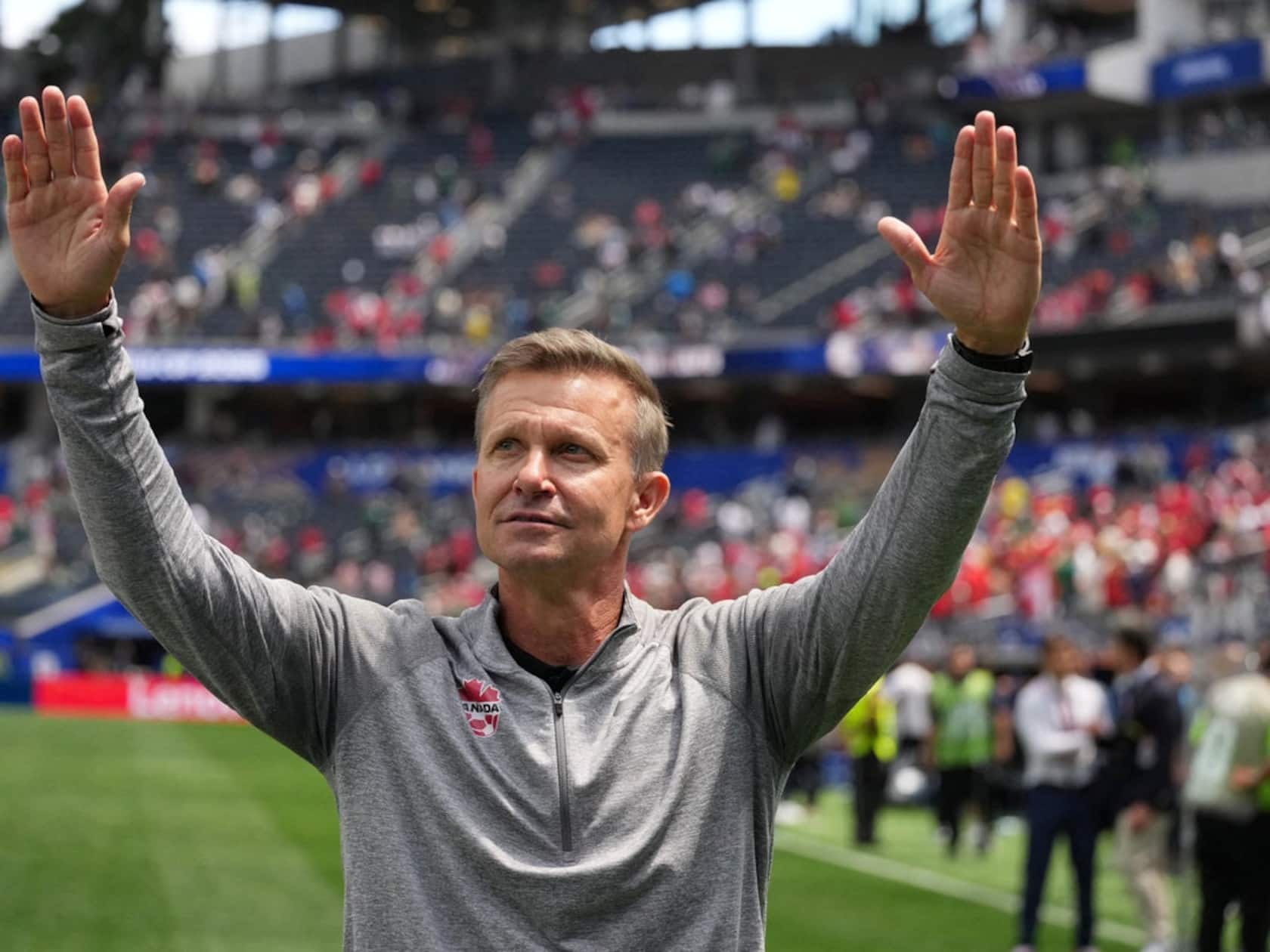
After Canada’s second goal in their 6-0 demolition of Qatar ten days ago, head coach Jesse Marsch delivered what became an online sensation — a moment many dubbed a “generational meme.” Sprinting along the touchline and punching the air with exuberance, as if he were a DJ hyping up a crowd in Ibiza, Marsch made it abundantly clear that he is unconcerned about public perception. On Sunday afternoon in Los Angeles, he demonstrated that beyond any doubt.
Moments after Stephen Eustaquio’s dramatic strike in the second minute of stoppage time sealed Canada’s progression to the last-16 at the expense of South Africa, Marsch gathered his 26 players and backroom staff into a tight circle on the pitch. Clad in a Team Canada sweatshirt — the same one whose badge the American later kissed in celebration — he told his squad that they had become “Canadian heroes” after achieving the nation’s first-ever World Cup knockout victory.
“Guys, think about the two years we’ve been together,” Marsch began, his words captured clearly by a nearby camera and microphone. “Think about how we’ve talked about sticking to the plan, staying true to who we want to be, playing aggressively, and showing your character.”
He continued passionately: “You guys are Canadian heroes; heroes for the future children of this country who will play this sport. This game has a bright future because of you. You should be proud of who you are and what you’ve done today. You went for it, moment after moment. You are Canadian heroes.”
It was quintessential Marsch — reminiscent of a live scene from an “All or Nothing” documentary. Love him or not, the former Leeds United manager embodies a belief in unity, emotion, and collective purpose that goes far beyond tactics or formations. When asked about the post-match speech in his press conference, Marsch had a pointed response for critics who viewed the moment as overly theatrical.
“Look, people like to say it’s performative to meet on the pitch,” he said. While the journalist hadn’t used that word, Marsch seemed aware of the perception that his management style carries a certain showmanship — even a cringe factor. His response was blunt: “I don’t give a s*** what people have to say. All I care about is our team and what we do together.”
As for why he chose to speak on the field instead of in the dressing room, Marsch explained: “It’s hard because after the game, everyone gets pulled in a million directions by the media, and you don’t really get the chance to be with your team unless you take that moment right there.”
He added, “I always try to get the leaders to speak because they’re Canadian. This is their national team, but I wanted to express how significant this moment will be for the sport in this country. It’s an honour to be their coach, and the responsibility I feel toward them drives me every day to prepare and create a platform for them to be their best. I think they achieved that today.”
The partnership between Canada and their American coach is striking, particularly during a period of subtle political tension between the two nations. Arm-in-arm with his staff, Marsch sang the Canadian national anthem, O Canada, before kick-off in Los Angeles. A former United States assistant coach from Wisconsin, Marsch has often faced accusations of insincere patriotism.
He dismissed such criticism outright. “Look, I am American and proud to be American, but I think the ideals and traits of Canadian people fit me really well,” he said. “They value kindness and generosity. It’s a country that welcomes outsiders and appreciates you for what you do more than what you say.”
He continued, “Sometimes Americans get a reputation for being loud, arrogant, or overly expressive — and I know that in many ways that might describe me, or at least how people describe me. But again, I don’t give a s***.”
Marsch’s unapologetic conviction is, in many ways, admirable. Foreign-born managers are often accused of lacking emotional investment in their adopted national teams, but the 52-year-old’s passion for his squad and their country is unquestionable. It has been a driving force behind Canada’s surge into the last-16, where they will next face either the Netherlands or Morocco in Houston on Saturday.
Marsch also revealed his softer, mentoring side when discussing Eustaquio’s moment of triumph. The midfielder, who scored Canada’s winner, has endured immense personal loss — his mother, Esmeralda, passed away from brain cancer in April 2023, and his father, Armando, died a year later from a heart attack.
“Steph is one of the most reliable people in the team and fully understands what we’re trying to achieve,” Marsch said. “Given everything he’s been through, with his parents passing away, he deserves this moment. He and his brother share an incredibly close bond. In a group full of amazing human beings, maybe Steph is the most deserving of all. I’m so happy for him — and I believe his parents are watching from above and saw that moment.”
Canada’s journey is far from over. Alphonso Davies, returning after seven weeks out with a hamstring injury, made an immediate impact — creating two chances and injecting pace into Canada’s attack. The 25-year-old Bayern Munich star is the nation’s only true world-class player and will be pushing to start in Houston. But whether or not Davies is in the lineup, Jesse Marsch will remain Canada’s commander-in-chief — leading with passion, conviction, and a total disregard for outside noise.