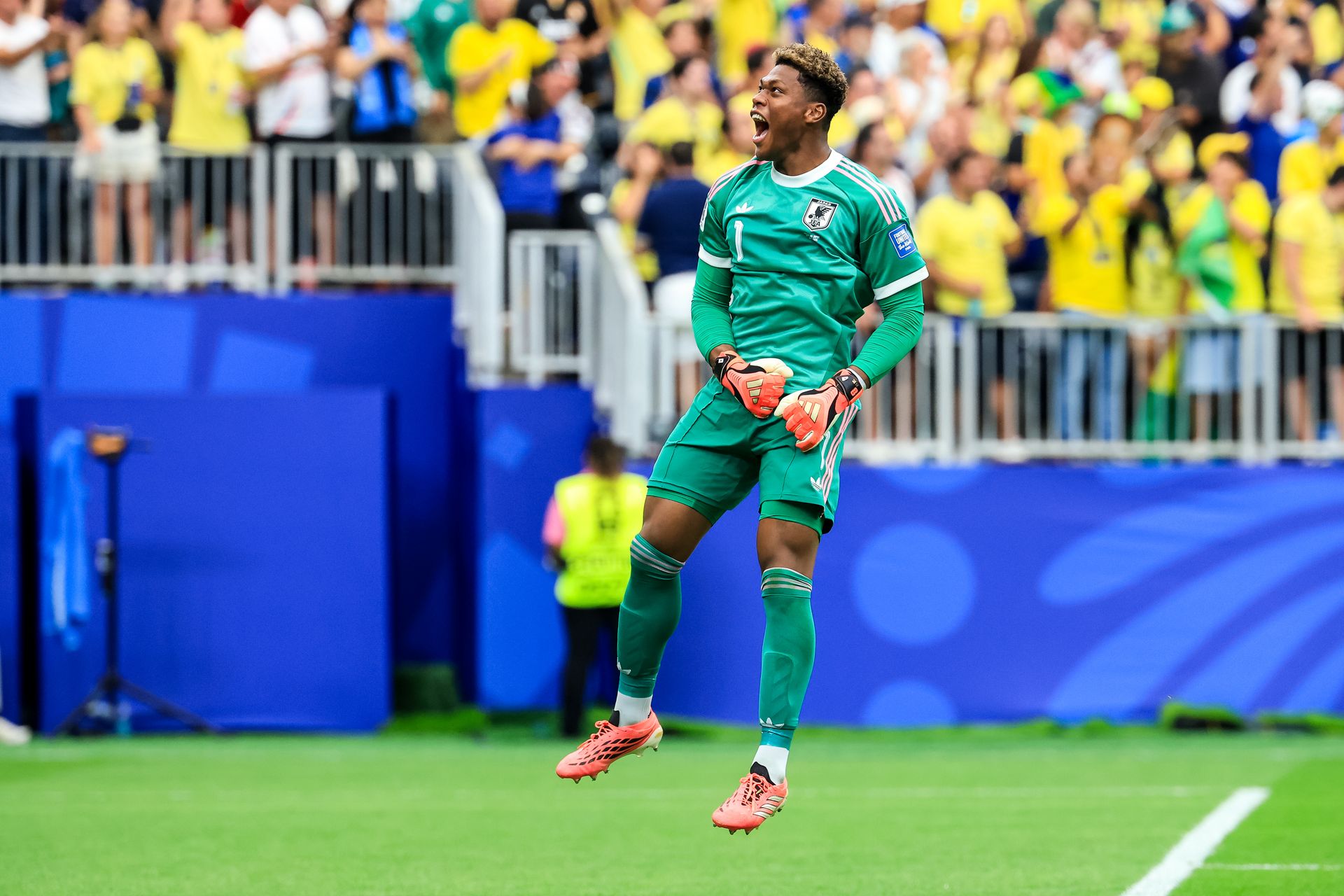
It ended in heartbreak for Japan as they fell short once again in the World Cup knockout stages, losing to Brazil in the sixth minute of stoppage time to bow out in the round of 32.
A recurring tendency to let key matches slip away from promising positions continues to haunt the Samurai Blue. Yet, despite the cruel nature of their World Cup 2026 elimination, the team’s steady development remains evident.
Among a squad brimming with young talent, goalkeeper Zion Suzuki stands out as one of the brightest prospects for the future.
Although Suzuki was beaten by Casemiro’s header in the second half, he produced two superb saves on either side of Brazil’s equaliser. One of those interventions denied Vinicius Jr what could have been one of the tournament’s most spectacular goals — a stop that was as remarkable as the goal itself might have been.
Gabriel Martinelli’s late strike sealed Brazil’s win, but for Suzuki, the journey is only just beginning.
So, who exactly is Zion Suzuki, and what are some key things you should know about him?
Unlike the other 25 members of Japan’s squad, Suzuki was born outside Japan. He first saw the light of day in Newark, New Jersey — the city best known as the home of the three-time NHL champions, the New Jersey Devils.
Just around 10 miles from The Rock (the Devils’ home arena) lies the New York New Jersey Stadium in East Rutherford, where the World Cup final is set to take place on Sunday, July 19.
Shortly after his birth, Suzuki’s family relocated to the Japanese city of Saitama, where he was raised in the former Urawa district and developed his passion for football.
Now 23 years old, Suzuki began his professional career with local J.League side Urawa Red Diamonds. However, he made only eight J1 League appearances for the club. He later spent time on loan at Belgian outfit Sint-Truiden before completing a move to Serie A team Parma in 2024.
Across his two seasons with the Reds, Suzuki’s eight senior appearances were complemented by several outings in Japan’s Levain Cup, the domestic equivalent of the League Cup.
Despite limited first-team opportunities at Urawa, he was trusted to play four matches in the 2022 AFC Champions League. The Reds went on to lift the continental title for the third time after defeating Saudi Pro League side Al-Hilal in a two-legged final.
Although Suzuki did not feature in either of the final legs, he received a winners’ medal and became a continental champion at just 20 years old.
When he joined Parma, Suzuki followed in the footsteps of one of Japan’s footballing legends — Hidetoshi Nakata. Nakata, now a successful sake entrepreneur and still a style icon, made his own move to Parma from Roma in 2001.
Nakata later went on to play for Bologna, Fiorentina, and Bolton Wanderers, while earning 77 caps for Japan during a decade-long international career.
Now closing in on his 30th international cap, Suzuki, who turns 24 in August, could realistically represent Japan for another decade — and in doing so, challenge several national records.
Japan’s most-capped goalkeeper remains Yoshikatsu Kawaguchi, who made 116 appearances for the Samurai Blue before retiring in 2010. While Suzuki could potentially surpass Kawaguchi’s milestone, the overall national record — held by midfielder Yasuhito Endo with 152 caps — still appears distant. Veteran defender Yuto Nagatomo, with 146 caps and still active at 39, is another reminder of the longevity required to reach such heights.
Within Japan’s current World Cup squad, Suzuki is by far the most experienced goalkeeper. Keisuke Osaka and Tomoki Hayakawa have a combined total of just 15 international appearances between them. Both are older than Suzuki and represent top J1 League sides — Sanfrecce Hiroshima and reigning champions Kashima Antlers respectively.
Beyond them, there is little international experience in the goalkeeping ranks. Nagoya Grampus’ Alexandre Pisano, who has a single cap at just 20 years old, remains eligible to switch allegiance to Canada.
Born in the United States, Suzuki was eligible to represent the American national team. Reports suggest that US Soccer closely monitored his progress and hoped to involve him at youth level. However, Suzuki chose to represent Japan — his mother’s country — from the under-15 level onwards, and has done so ever since.
His father is Ghanaian, which technically made Suzuki eligible to play for three different nations. Yet, there has never been any indication that his commitment to Japan wavered.
Suzuki’s association with Urawa was a long one — he joined their academy at the age of six and remained with the club until 2024, when his move to Italy’s Emilia-Romagna region was finalized.
He signed a five-year deal with Parma, despite an earlier agreement to extend his stay at Sint-Truiden, where he was part of a lineage of Japanese goalkeepers at the Belgian club.
Firmly established as Parma’s first-choice goalkeeper, the 2025–26 season, however, did not unfold as he would have hoped. Suzuki fractured a bone in his hand during a match against AC Milan in November, sidelining him for four months. As a result, he featured in only 20 Serie A games — possibly his last campaign in Italy.
Despite that setback, Suzuki’s name continues to surface in transfer rumours involving major European clubs seeking reinforcements between the posts. Both Chelsea and Manchester United have been linked with him over the past couple of years. More recently, Aston Villa and Newcastle United have also been reported as interested suitors.
Following a World Cup in which he produced a series of outstanding saves to significantly raise his profile, it wouldn’t be surprising if his agent’s phone starts ringing with offers sooner rather than later.