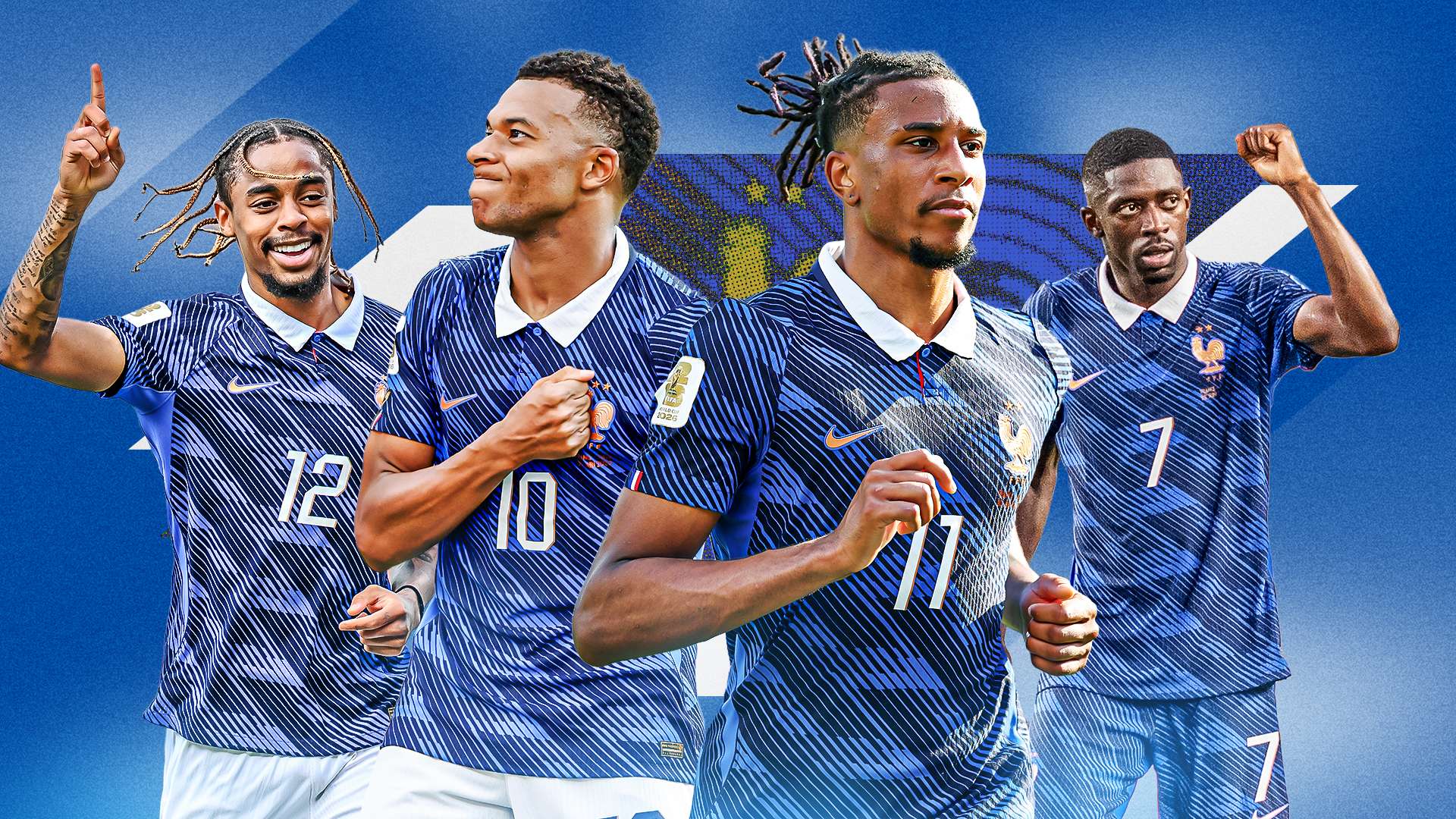
France’s attacking unit has arguably been the most electrifying feature of the 2026 World Cup so far. Having swept through the group stage with three straight wins, Les Bleus continued their dominance by overcoming Sweden 3-0 in the round of 32. At this point in the competition, they stand as the top scorers with 13 goals. Kylian Mbappe, now leading Real Madrid’s frontline, has been the main man once again, finding the net six times in just four matches.
Ousmane Dembele, the current Ballon d’Or holder, has also been outstanding, sitting only two goals behind Mbappe and Argentina’s Lionel Messi in the Golden Boot race. His scintillating hat-trick in the 4-1 victory over Norway was instrumental in securing France’s position at the top of Group I.
Michael Olise might not have scored yet — his acrobatic overhead kick against Sweden rattled off the post — but the Bayern Munich playmaker has already tallied five assists, demonstrating his immense creativity and vision in attack.
What makes France’s frontline even more remarkable is the depth at Didier Deschamps’ disposal. He has seamlessly rotated between Bradley Barcola and Desire Doue, who have scored three goals between them. If this blistering form continues through the final stages of the tournament, the current French attacking quartet could find themselves ranked among the most iconic forward lines in World Cup history.
Here’s a look back at six of the greatest attacking units ever to grace the World Cup stage:
6. West Germany, 1954
Though West Germany’s 1954 triumph was considered a surprise, their victory was far from undeserved. After being dismantled by Hungary in the group stage, Sepp Herberger’s side displayed incredible resilience to overturn a two-goal deficit in the final and defeat the same opponents. Captain Fritz Walter orchestrated the attack brilliantly, holding the all-time record for World Cup assists with nine. Max Morlock chipped in six goals, including the crucial strike that halved the deficit in the final after West Germany’s disastrous start.
Helmut Rahn became the hero of Bern, scoring the equaliser and, later, the dramatic winner with just six minutes left. Alongside Rahn, Hans Schafer and Ottmar Walter also netted four goals each, as West Germany finished the tournament with 25 goals — still the second-highest total in World Cup history.
5. France, 1958
Just Fontaine’s 13 goals at the 1958 World Cup remain one of football’s most extraordinary feats. Although he famously admitted that watching a young Pele made him consider retirement, Fontaine’s own brilliance was undeniable. His lethal finishing helped France finish third, but he was also backed by the exceptional playmaking of Roger Piantoni and Raymond Kopa. Both scored three goals, and Kopa — who later won the Ballon d’Or that year — set a record with nine assists in a single tournament, a record that still stands today.
4. Netherlands, 1974
The 1974 World Cup was set up to be Johan Cruyff’s crowning moment. After revolutionising football with Ajax and their brand of ‘Total Football’, Cruyff led a Dutch team that seemed unstoppable under Rinus Michels. With Johnny Rep and Rob Rensenbrink on the flanks and Johan Neeskans offering attacking support from midfield, the Netherlands dazzled the world. Cruyff contributed three goals and three assists, while Sweden’s Jan Olsson, who was famously on the receiving end of the first ‘Cruyff turn’, later called it the proudest moment of his career.
Although the Netherlands were defeated in the final by West Germany after surrendering a one-goal lead, Cruyff was named the tournament’s best player. His supporting cast — Rep, Rensenbrink, and Neeskans — combined for ten goals, ensuring their place in football folklore.
3. Hungary, 1954
The ‘Mighty Magyars’ of Hungary are often remembered as the greatest team never to lift the World Cup trophy. Entering the 1954 tournament unbeaten since 1950, they were considered an unstoppable force. Led by Ferenc Puskas, Sanco Kocsis, Nandor Hidegkuti, and Zoltan Czibor, Hungary’s attack was devastatingly efficient. Of their 27 goals, only five came from players outside that quartet. Kocsis alone scored 11 times, helping Gusztav Sebes’ side reach the final despite Puskas missing key knockout matches through injury.
Even though they remain the highest-scoring team in a single World Cup, their campaign ended in heartbreak with a shock defeat to West Germany in the final — a result forever remembered as ‘The Miracle of Bern’.
2. Brazil, 2002
The 2002 World Cup in Japan and South Korea marked Ronaldo’s ultimate redemption story. Four years after his health scare and disappointing final in 1998, he led Brazil to their fifth world title, scoring eight goals in seven matches — including both in the 2-0 final victory over Germany. However, this was far from a one-man show. Rivaldo was instrumental, earning Player of the Match honours against Belgium and England, while Ronaldinho brought flair and magic to the attack, famously scoring a stunning free-kick past David Seaman before being sent off later in the same match.
This trio — Ronaldo, Rivaldo, and Ronaldinho — epitomised Brazilian brilliance, combining creativity, skill, and ruthlessness in front of goal.
1. Brazil, 1970
Brazil’s 1970 team is still widely regarded as the finest international side in football history, thanks to their breathtaking forward line. Rivellino’s thunderous left foot, Tostao’s intelligence and work rate, and Jairzinho’s record of scoring in every match set them apart. Yet it was Pele, ‘The King’, who shone brightest. After his injury struggles in 1966, he returned to reclaim his throne, scoring four goals and leading Brazil to their third World Cup title.
That team’s dazzling display of ‘Jogo bonito’ — the beautiful game — captivated fans worldwide and set an enduring standard for attacking football excellence.