The threat of cyber fraud on WhatsApp is continuously increasing. The latest case has come to light that the WhatsApp account of BJP MP and party spokesperson Sambit Patra was hacked. Not only was Patra's WhatsApp account hacked but people were asked for money from his number. Meanwhile, the government has also become alert about the increasing scams on WhatsApp. Every day millions of people around the world have their WhatsApp accounts hacked or taken over. Taking action on this, WhatsApp is banning about 1 crore accounts in India every month, but fraudsters are targeting people in a new way. In such a situation, the question arises that how many people become victims of such scams every day and what is the way to avoid it.
BJP MP and party spokesperson Sambit Patra told on Twitter that his WhatsApp account was hacked. After this, messages asking for money were sent from his number to the people in the contact list. Messages were sent to many people asking for money up to Rs 55 thousand. When the person in front was asked to take cash, he refused and insisted on online payment only. After this it became clear that the account was in the possession of cyber criminals. Sambit Patra appealed to the people not to send money, terming all such messages as fake and said that information about the matter has been given to senior officers of Odisha Police.
This is not the first time that the WhatsApp account of a famous person has been hacked. Earlier, NCP SP MP Supriya Sule and actress Swara Bhaskar have also publicly informed about the hacking of their WhatsApp accounts. Last year, the account of BJP leader Dinesh Chand Sharma was also taken over by cyber criminals. During that time, messages asking for money were sent to thousands of his contacts. It is clear from these cases that cyber criminals are targeting not only common people but also people associated with public life.
According to court claims, more than 1,000,000 (10 lakh) WhatsApp accounts are hacked or taken over every day across the world. Talking about India, here too thousands of accounts are hacked every day. No official and accurate data of this is released publicly by the government or WhatsApp (Meta). However, every day thousands of complaints of account hacking and fraud are registered on the cyber crime helpline. This is why Meta bans lakhs of accounts every month on the basis of complaints.
WhatsApp is one of the most secure messaging platforms, yet it gets hacked due to social engineering and your carelessness rather than any technical flaw (bug). Hackers mainly use OTP theft, ghost pairing, QR code scanning and SIM swap methods to hack accounts.
According to Meta, many criminal gangs operating around the world target people using different platforms. The company said that in the first six months of this year, about 68 lakh WhatsApp accounts were removed, which were related to criminal scam centers. Along with this, WhatsApp has also introduced new security features, which include showing security information when an unknown person is added to the group and warning before replying to suspicious messages. The company says that it is important to thoroughly investigate any unknown message, tempting offer or message asking for money before trusting it, because many scams start from one platform and reach another.
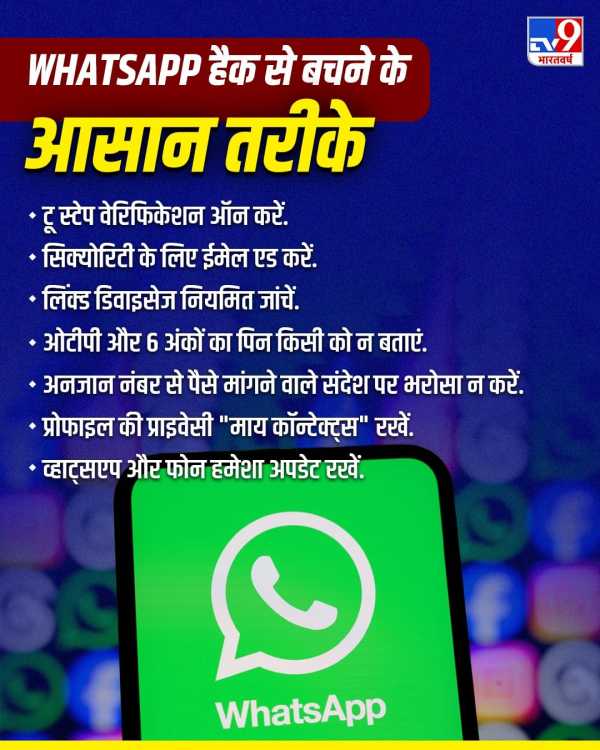
1. Must turn on two step verification- The most important security setting of WhatsApp is two step verification. After turning it on, a 6 digit PIN will also have to be given while logging in to the new device. With this, no one will be able to activate your account on their phone just by getting the OTP. To turn on two-step verification, go to Settings > Account > Two-Step Verification > Turn On.
2. Must add email address - Add your email along with two step verification. If you ever forget the PIN, it can be reset through this email. It may be difficult to get your account back without email.
3. Check linked devices regularly – For this go to Settings > Linked Devices. If your WhatsApp is open on any unknown computer or device, then remove it immediately.
4. Do not share OTP and 6 digit PIN with anyone – WhatsApp, bank or any government agency never asks for OTP or security PIN over phone or message. If anyone asks for this then understand that he may be a fraud.
5. Be careful of unknown calls and messages - If any unknown number is asking for money, luring you for a job, reward or investment, then first confirm his identity. Don't pay in a hurry.
6. Strengthen privacy settings – Keep your profile photo, last seen, about and status on My Contacts instead of Everyone or Nobody as per your need. With this, your personal information will not reach unknown people.
7. Do not ignore security updates – Always keep WhatsApp and your phone software updated. Security related flaws are fixed in the new update.
According to government officials, WhatsApp is banning an average of 98 lakh or about 1 crore accounts every month in India due to violation of its policies. 99 lakh accounts were closed in January, 97 lakh in February, 1.11 crore in March, 97 lakh in April, 1.12 crore in May, 98 lakh in June, 89 lakh in July, 82 lakh in August, 1 crore in September and 91 lakh in October. That means, on an average, action is being taken on about 3.2 lakh accounts every day. However, it is not necessary that all the accounts have been hacked, but these also include accounts related to spam, fraud and other rule violations.
According to government officials, about 95 percent of cyber frauds done through digital arrest and identification are done through WhatsApp. Once an account is created with a mobile number, such OTT platforms can run even without a SIM card, making it more difficult for criminals to reach out. According to the data of the Department of Telecommunications, following government instructions, about 29 lakh WhatsApp profiles and groups have been closed till November. According to government data, in the year 2024, cyber criminals defrauded people of Rs 22,845.73 crore, which was 206 percent more than last year.