
“FY26 was a good year for us. The effort was to make sure that we balance growth and profitability,” Saurabh Garg, cofounder and chief business officer of NoBroker, tells Inc42.
NoBroker, which claims to be India’s largest proptech platform, has spent a decade arguing that keeping nearly 90% of its users free is not a flaw in the business model; it is the business model. What has changed is what sits on top of that free layer. And indeed, now, it seems NoBroker is making a big push for monetisation with multiple services bundled on top.
Garg claims NoBroker recorded over 1 Lakh real estate transactions in March 2026 alone, with the home services business clocking in 1.5 Lakh orders, quietly overtaking real estate transaction volume.
The company that started as a listings platform is transitioning towards the home services model, with rentals taking a backseat somewhat.
NoBroker has not yet filed its numbers for FY25 or FY26. When we last saw the company’s financials back in 2024, the situation was similar to most other consumer services companies: high losses.
Since then NoBroker has expanded into multiple areas. Garg says they are paying off, but will they deliver profits?
The Freemium Engine Kicks InFounded in 2013 and having raised $368 Mn to date from marquee investors like General Atlantic, Tiger Global Management, Google, and Elevation Capital, NoBroker’s revenue today flows from three distinct verticals — real estate, financial services, and home services.
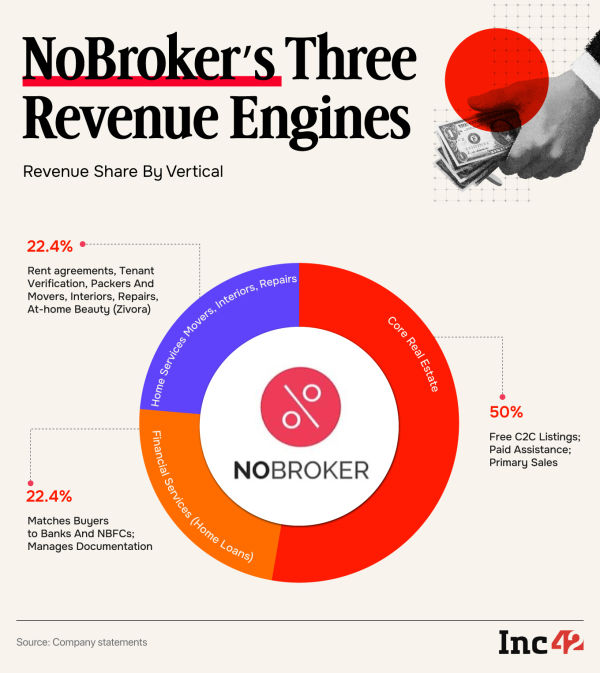
According to the financials shared with Inc42, core real estate contributes roughly 50 to 55% of total revenue, with financial services and home services splitting the remaining 45% roughly equally.
NoBroker’s Garg tells us that the company’s efforts to build a monetisation layer on top of core real estate services have started to yield results with the revenue share from this vertical declining from 90% in FY24 to nearly 50% in FY26.
In FY24, NoBroker’s revenue stood at ₹803 Cr in FY24 of which 90% came from core real estate business. The losses stood at ₹411Cr. And as mentioned above, the company has not filed its audited FY25, FY26 financials.
The CBO tells us: “The first milestone for us is to become profitable, which we plan to do in the next 12-15 months.”
But Garg is nevertheless bullish because of what NoBroker has built over the past two years.
He says the proptech business model is evolving and everyone wants to be in multiple verticals. Having a big user base is essential for times when the market slows down.
Even the likes of Square Yards, Magicbricks are acquiring users for free at the transaction stage and then cross selling paid services at every subsequent moment in the home buyer’s journey and lifecycle.
NoBroker’s original model of connecting home owners with potential tenants was not monetisable enough. NoBroker charges approximately ₹3,000 per month per user for premium services, but not many users were opting for this consistently. Plus, those who did only chose a premium plan once every 12 months, which does not seem sustainable.
The platform’s ability to monetise is therefore concentrated in a narrow window around the transaction, and 90% of users, even if they transact on the platform, might never pay NoBroker.
Garg says that NoBroker’s revenue mix now skews toward the home-buying marketplace rather than rentals, with the former bringing in 60% of the volume. Although different from the original model, this has helped the company scale the top line and bolster margins.
The average property resale transaction size on NoBroker is ₹89 Lakh, while a primary sale — a new developer launch — comes in at ₹1.4 Cr, compared to the paltry ticket sizes of rentals.
The commissions are higher, and naturally, even at a low volume, NoBroker can build a sizable revenue scale. Garg says NoBroker processed ₹1,000 Cr in primary sales transactions in March 2026, which was a landmark figure for the company.
NoBroker’s positioning in the beginning was disrupting the rental transaction market by replacing brokers, and now that has come full circle. It is earning what is functionally a broker’s commission from developers, replacing traditional channel partners who charge somewhere between 2% and 4% on deal value.
Garg did not reveal how much the company charges, but the model remains the same.
But besides getting people into houses, NoBroker’s three other revenue verticals include financial services, real estate services and home services.
Financial Services And BeyondOn the first, it principally earns money from home loan aggregation, which is the most natural extension of its original value proposition in the financial services space. Today, this has a revenue contribution of roughly 22.4% in FY26, according to Garg.
Under the model, NoBroker matches buyers to banks and NBFCs based on their financial profile, manages the documentation and orchestration process, and earns a referral fee from the lending institution.
The borrower pays nothing directly to the platform.
“The friction being replaced is a notoriously opaque and fragmented home loan process — multiple bank visits, inconsistent eligibility guidance, manual paperwork and NoBroker’s technology layer sits as an intermediary that benefits both the buyer and the lender,” Garg says, adding that the vertical grew approximately 2.5 times in the last year.
Competitors like Square Yards, Magicbricks, InfoEdge-operated 99 Acres have all partnered with NBFCs and banks for similar loan products as well as loans to brokers and real estate businesses working with the platform.
Industry observers say that real estate platforms do have some advantage over other lending platforms. While lending platforms, banks or NBFCs need to spend on customer acquisition, the likes of NoBroker, Housing.com and others have verified customer leads from the get-go.
The challenge for NoBroker, as with every other business in its repertoire, will lie in its ability to keep users inside its funnel through the full transaction.
If a buyer discovers a property on NoBroker but closes and finances through the developer’s sales office, the loan referral fee vanishes. And this happens more often than one might imagine in the home buying vertical.
Will Services Push Pay Off?Upselling tenants and potential buyers to buy NoBroker’s real estate services such as home registration, rental agreements, home improvement, moving and packing, interior design is the second frontier opened up by the company’s user base advantage.
In this regard, NoBroker has an edge because it is organising segments that have been left untouched by most other startups, but the quality of service is paramount in this space.
Finally, the home services and beauty vertical is NoBroker’s most ambitious new bet, which also has a similar pain point.
It is looking to take on Urban Company, Snabbit, Pronto and others in the space through its Zivora vertical. Overall, NoBroker offers beauty services, appliance repair, home cleaning through the home services vertical.
Cross-selling is at the heart of this push. Each of these verticals is a hook designed to keep the user inside the NoBroker ecosystem rather than defaulting to a search engine or a WhatsApp group.
Garg says that entering the home services businesses means the customer retention is high, because these customers are more prone to return to NoBroker after one great experience.
A user who transacts for free on the core product but pays for three or four adjacent services may generate more total revenue than a paid subscriber who uses only the core product.
The NoBroker cofounder indicates that ancillary businesses like financial services and home services combined now contribute nearly 50% of total revenue, up sharply from their historical share.
NoBroker’s Losses Under The SpotlightThe unanswered questions in our case, when we spoke to Garg, were around the financials, profitability, margins and how revenue has grown for the full year since 2024, when the company last filed its numbers.
Has NoBroker been able to build a sustainable business?
What we do know is that home services is an operationally intensive segment with famously thin margins, high risks involving professionals and gig workers, and strong affinity to local unorganised players and well-capitalised competition from startups.
NoBroker’s Zivora is entering a space where Urban Company and Yes Madam have spent years and significant capital building supply-side density. NoBroker’s advantage in each of these segments is the user base and the high brand recall for home and rental needs, but this alone does not guarantee a margin win.
Garg and Co’s ability to monetise NoBroker’s user base will be a big challenge.
Besides, the vertical expansion also means that it no longer has a single competitor. To a certain degree, NoBroker competes with 99acres, MagicBricks, Housing.com, MyGate, Urban Company, Snabbit and Pronto, Homelane, Livspace among others. Even if it forms partnerships, the revenue upside will not be great.
Garg says the focus now is to deepen the presence in the existing markets and gradually expand to remote towns and cities.
“We are still scratching the surface, and a huge market is underpenetrated beyond tier 1 cities and metros where the market is dominated by the unorganised players and local word-of-the-mouth still has a huge leverage in renting out or buying real estate,” he adds.
What NoBroker has built is a user acquisition funnel which could become its competitive edge as the home services vertical matures. But as we know from the state of Urban Company and others, this still doesn’t guarantee profits.
[Edited By Nikhil Subramaniam]
The post NoBroker’s Future Is Beyond Home Listings, But Will Profits Follow? appeared first on Inc42 Media.