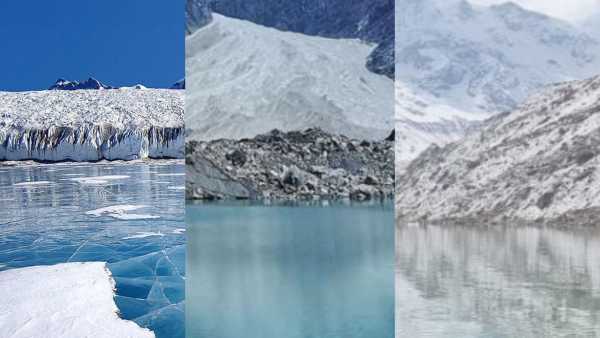
Earth's temperature is increasing. The snow of the mountains is melting and a big danger is arising from that melting snow. Scientists have warned that at the rate at which the world's glaciers are melting, more than fifty thousand new lakes may be formed in the snow-covered areas in the coming years and if this happens, the world may have to face devastating floods.
A team of researchers from Sweden's Uppsala University, America's Carnegie Mellon University, Switzerland's University of Lausanne and Norway's University of Oslo have prepared this shocking report after studying many glaciers in Antarctica. Due to the melting of glaciers, millions of tonnes of water accumulates between the mountains every day.
In the beginning it is just a small reservoir, but with the passage of time this water takes the form of a huge lake. These lakes look very beautiful when seen from above, but scientists are considering them as a sign of impending disaster. After research on all the glaciers, scientists warn that due to the melting of glaciers in Antarctica, there is a possibility of formation of 56,659 lakes, which can prove to be a big threat to Asia, Andes, mountain ranges, Alaska and Arctic in the future.
To understand this danger, you have to understand the process of formation of these lakes. When a glacier melts, its water accumulates at one place. Hard ice and stones form a natural dam-like structure. Gradually the amount of accumulated water increases and if that natural dam breaks, it can lead to a sudden flood.
That means the danger is not just from the melting of ice. The real danger comes from the water that gets trapped between the mountains. Because there is no strong concrete dam blocking these lakes but there is a natural wall of ice which can break at any time. Scientists call this phenomenon GLOF i.e. Glacial Lake Outburst Flood.
According to scientists, Glacial Lake Outburst Flood is not like any normal flood. In a normal flood, water rises slowly, but in GLOF, millions of cusecs of water rushes down the glacier in a few minutes. It carries away with itself rocks, trees, soil, bridges, roads and buildings. This is the reason why it is counted among the most dangerous mountain disasters in the world. Many parts of the world have already faced this destruction and after the latest report many countries may be in danger.
New research by scientists shows that the biggest impact of new glacial lakes formed in the coming years can be seen in four areas: the Himalayas of Asia, the Andes ranges of South America, Alaska and the Arctic region of North America. These four areas are among the fastest changing snow regions in the world.
Now the question arises whether this danger can be avoided. Does the world have any system that can warn people before these lakes burst? Scientists are clearly saying that if the pace of global warming continues to increase like this, then the number of glacial lakes formed in the mountains will also continue to increase. That means the threat is not ending, but is becoming bigger every year.
Scientists believe that this danger cannot be completely stopped, but its impact can definitely be reduced to a great extent. For this, it is most important that the lakes at risk are continuously monitored, their scientific assessment is done and timely warning is sent to the people living in the low-lying areas.
Often we think of glaciers as just mountains of ice. But the truth is that these glaciers are connected to the entire earth's water cycle, weather and the lives of millions of people. When a glacier retreats, the ice doesn't just melt. The entire ecosystem changes with it. Therefore, scientists are repeatedly saying that conservation of glaciers is not only an environmental issue but also a question of human safety, water security and future generations. Now the decision is in the hands of humans whether they want to change themselves or not. Because nature does not change its rules.