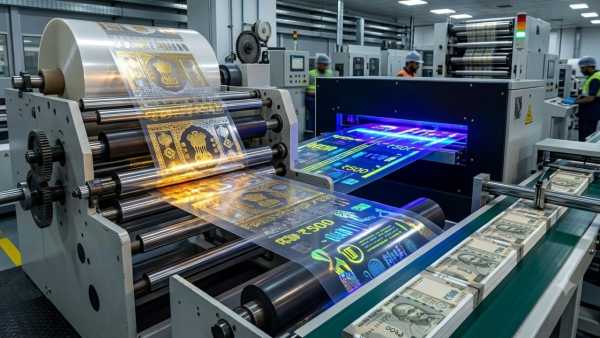
The Government of India and the Reserve Bank of India have approved the trial of plastic notes of Rs 10 and Rs 20. After this, the question is arising in the minds of people that how plastic i.e. polymer notes are prepared. What technology is used in these notes and how are they different from paper notes. Let us understand in simple language the entire process of making plastic notes.
Plastic notes were invented by David Solomon. Work on this project started in 1988 at the request of the Reserve Bank of Australia and it took about 20 years to complete. Australia issued the first 10 Australian dollar polymer note in 1988. After this, by 1996, it became the first country to convert its entire currency into polymer notes. Later, the Bank of England also adopted this technology in 2016 with the 5 pound polymer note featuring Sir Winston Churchill.
The basis of plastic notes is a transparent plastic material called BOPP i.e. Biaxially Oriented Polypropylene. There are no fibers or holes in it, so it does not absorb water, dirt and sweat. A portion of the note is left transparent, making it almost impossible to copy with a scanner or printer. Apart from this, technologies like diffraction grating and optically variable devices are used in them, due to which the color and pattern of the note appears to change when viewed from different angles.
According to reports, transparent polymer sheet i.e. BOPP is prepared first. The design and photographs of the note are printed on both its sides. The sheet is then sent to the foiling machine, where foil tape with security features is applied. After the printing is completed, the note is given UV treatment and a protective layer is applied on it, so that the ink remains safe for a long time. Finally, different notes are prepared by cutting the big sheet with a guillotine cutter. The finished notes also undergo various types of testing so that they can work properly with ATMs and cash counting machines.
Ordinary bank notes are made from long fibers of cotton comber and linter. To add security thread to these, the windowed thread technology of Britain's Portals company is used. Whereas polymer notes are considered stronger and their lifespan is about 2.5 times longer than paper notes. These are completely waterproof, do not get spoiled in water, do not tear easily and can be used for a long time. This is the reason why many countries of the world have started using them.