Genesis has established itself as a serious player in the mid-luxury car space since launching as a standalone brand a decade ago, but Hyundai’s premium marque had never really fielded a proper flagship. That changed on Wednesday, when the company finally revealed the GV90. Positioned as the brand’s first full-size SUV and its most ambitious production model so far, the GV90 is a large electric three-row SUV designed around comfort, indulgence and high-end luxury.
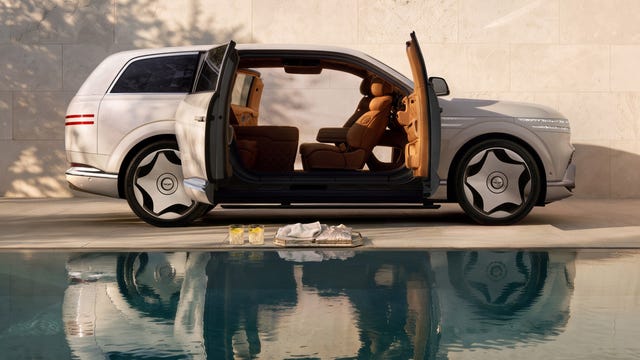
The standard version goes straight up against rivals such as the BMW X7 and Mercedes-Benz GLS-Class, but the story becomes even more compelling with the GV90 Neolun configuration, which introduces what is likely to become the SUV’s defining feature. The two-row version of that model is aimed at the Mercedes-Maybach GLS, and like that SUV, it serves as a more luxury-oriented derivative of the regular version. Unlike the Maybach, however, it makes that mission obvious with an extravagant set of pillar-less coach doors that Genesis appropriately refers to as the “Neolun Arch Gate.”
Those distinctive doors, which first slide and then swing outward from a rear hinge, open up to reveal the central idea behind the GV90 Neolun: a vast, lounge-like cabin intended to move Genesis a step closer to the ultra-luxury segment. The flooring uses genuine wood veneer with heating integrated directly into it, while similar warming functions are also built into the door cards and armrests. In parked two-row models, the front seats can rotate backwards, creating a four-person conversation area that fully takes advantage of the roomy interior.
While the 23.6-inch-wide central screen handles conventional infotainment functions while driving, it can expand when the vehicle is stationary, increasing to 1.7 times its size into a 24.6-inch display for uses more commonly associated with a television. A large 25-inch head-up display takes the place of a traditional instrument cluster, and Hyundai’s new Pleos Connect operating system underpins the entire interface and digital experience.
Genesis is also emphasising the safety measures developed to compensate for the unusual B-pillar arrangement on Neolun-equipped versions, where the pillar moves with the rear doors. According to the company, the body structure incorporates a roll cage within its reinforced cabin, creating a structure that is 50 percent more rigid than what it calls a conventional vehicle. That, together with a world-first roof airbag, is intended to help the pillar-less SUV match more conventionally constructed vehicles in crash testing.
The exterior styling closely echoes the Neolun concept first shown in 2024, with the placement of the door handles and the bright metal detailing where a B-pillar would normally sit acting as the clearest indicators of a coach-door version, while the regular GV90 uses a more conventional setup. As seen on many other Genesis models, the brand’s signature two-line lighting treatment extends from the grille across the front wings and, in this case, follows the G90 by stretching even beyond the front wheels.
Genesis says the GV90 rides on a flagship-specific architecture known as eMP, making it an EV-only model for the foreseeable future. A large 123.5-kWh battery is estimated by Genesis to deliver a 310-mile range in the three-row version, and the company says a 350-kW fast charger can replenish the battery from 10 to 80 percent in about 22 minutes.
The dual-motor powertrain produces 657 hp and 590 lb-ft of torque, sending power to all four wheels. An electronic limited-slip differential for each motor helps apportion torque to each individual wheel as required. A multi-chamber air suspension is designed to balance ride comfort with the stiffness needed in corners, while rear-wheel steering of up to five degrees improves manoeuvrability.
Genesis has yet to reveal pricing for either the GV90 or the GV90 Neolun, but it has confirmed that a limited run of early vehicles will be offered as the exclusive GV90 Neolun First Edition. These versions will be four-seaters available in one of three Genesis-defined specifications, each pairing a two-tone exterior with a different brightly coloured interior selected from the brand’s options palette, including shades of purple, green, and a vivid brown that comes close to orange.