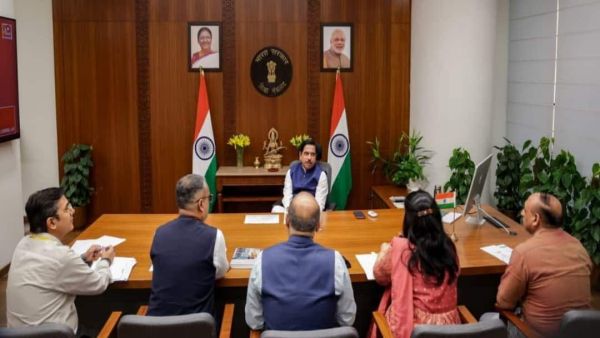
Union Education Minister Pralhad Joshi held a review meeting with senior officials of the Department of School Education and Literacy to discuss issues related to the Central Board of Secondary Education (CBSE). The discussions covered academic, examination, and administrative matters, with an emphasis on improving the board's functioning and strengthening support for students and teachers.
Joshi shared details of the meeting through a post on X, "Convened a meeting with senior officials of the Department of School Education and Literacy, @EduMinOfIndia, to discuss issues pertaining to CBSE," Joshi wrote in a post on X.
Convened a meeting with senior officials of the Department of School Education and Literacy, @EduMinOfIndia, to discuss issues pertaining to CBSE. The meeting reviewed key priorities for strengthening CBSE’s academic, examination and administrative processes, with a focus on… pic.twitter.com/3ichAWryzc
— Pralhad Joshi (@JoshiPralhad) August 24, 2026
According to the education minister, the review covered several priority areas linked to CBSE's academic and examination systems, as well as its administrative processes.
"The meeting reviewed key priorities for strengthening CBSE's academic, examination and administrative processes, with a focus on greater efficiency, transparency and improved support for students and teachers," he said.
The meeting assumes significance as CBSE continues to face discussions around examination processes; academic implementation and the practical challenges schools may encounter while adopting new policies.
The review comes at a time when the implementation of CBSE's three-language policy for Class 9 students under the National Education Policy (NEP) 2020 is being examined by the Supreme Court.
On August 20, the apex court raised questions about several practical aspects of the policy. These included the availability of textbooks and trained teachers, the possible academic burden on students, and how schools across the country would implement the language requirement.
A bench comprising Chief Justice of India Surya Kant and Justices Joymalya Bagchi and V Mohana was hearing petitions challenging the CBSE three-language policy.
The petitioners highlighted concerns over the availability of learning resources and teachers for the Indian languages included under the scheme. The court was also informed that some schools had not yet received textbooks for particular languages.
Senior advocate Anand Grover questioned how students could be expected to study an additional language when essential learning material was not available.
Appearing for the CBSE and the Centre, Additional Solicitor General Aishwarya Bhati explained that the language scheme would involve internal assessment.
She also clarified that students would not be held back in Class 9 merely because they failed to qualify in the additional languages introduced under the policy.
The court also discussed the position of students who are already learning foreign languages. It clarified that students studying languages such as French would not have to discontinue them.
Chief Justice Surya Kant said there was "no question of boycotting languages taught earlier" and underlined the need to respect all languages.
The availability of teachers for different languages was another major issue considered during the hearing. Sanskrit was among the languages specifically discussed in the context of teacher availability and the practical implementation of the policy.
Bhati told the court that 99.19 per cent of CBSE schools had already complied with the requirement to teach two Indian languages. However, approximately 235 schools were still not compliant with the requirement.
The discussion highlighted the difference between framing an education policy and ensuring that schools have the necessary infrastructure, teachers and learning resources to implement it effectively.
The Supreme Court indicated that the three-language policy would have to be assessed from both constitutional and practical perspectives. The issues under consideration include the classification of languages, availability of teachers, access to textbooks and the potential academic burden on students.
Against this backdrop, the Education Minister's meeting with senior officials places renewed focus on improving CBSE's academic, examination and administrative systems.
For students and parents, the discussions are particularly relevant as changes in CBSE policies and processes can affect classroom learning, examinations and the overall academic experience. The emphasis on efficiency, transparency and improved support also points to the importance of ensuring that policy decisions are backed by effective implementation at the school level.