The combination of growth at the highest in six quarters and monthly inflation at a record low has complicated the task of the Reserve Bank of India (RBI), leaving markets divided about the likely outcome of the monetary policy committee (MPC) meeting this week. In a poll of 20 economists, 12 leaned toward RBI cutting the key rate by 25 basis points (bps) to 5.25% this Friday. The remaining eight, including State Bank of India, expect RBI to keep policy rate unchanged.
The central bank has cut the rate by 100 bps (1 percentage point) to 5.50% since February and has maintained a pause since August. Against this, rates on outstanding loans have dropped 54 bps, while those on outstanding deposits have fallen 20 bps. Rates on fresh loans are down 100 bps and fresh deposits by 89 bps.
Notably, two institutions that previously projected a rate cut have revised their expectations.
Barclays and Icra Ratings made the revision following the release of the latest GDP data and now see RBI maintaining the status quo.
On the other side are economists who point to lower nominal GDP growth, elevated tariff-related risks, the possibility of inflation coming in below RBI’s projections in the next fiscal year and a prevailing sentiment of “if not now, then when.”
“We no longer expect the RBI MPC to cut the policy rate in the upcoming meeting,” said Aastha Gudwani, India chief economist at Barclays Bank. “Friday's second quarter FY26 real GDP growth surpassed our and RBI's expectations. We acknowledge that growth has peaked and expect second half FY26 growth to slow versus the first half.”
Gudwani had previously called for a rate cut, citing inflation was “too low to ignore.”
Against the RBI projection of 6.8% growth in July-September, the Indian economy grew 8.2%, the fastest in the previous six quarters. Nominal GDP grew at 8.7% in the second quarter, versus 8.8% the year before.
Along with this, retail inflation slowed to 0.25% in October. That’s the lowest since the current series began in 2015.
RBI has forecast 2.6% inflation for FY26, 4% in the fourth quarter of FY26 and 4.5% in the first quarter of FY27. The central bank revised its full year FY26 inflation estimate downwards to 2.6%, from 4.2% in February.
“FY26 estimated inflation is now tracking less than 2%, implying risk of a further undershoot of about 50-60 basis points to RBI’s FY26 inflation forecast,” said Madhavi Arora, chief economist at Emkay Global Financial Services. “This could support the case for a December rate cut. However, it's a close call.”
Most economists anticipating a rate cut have expressed a similar view.
“The low nominal growth numbers at 8.7% in the second quarter of FY26 do signal that there is need for caution,” said Sakshi Gupta, principal economist at HDFC Bank. “This year, the story has been about growth overshooting and inflation undershooting. Therefore, the upcoming RBI rate decision remains a close call.” She sees space for a 25-bps rate cut.
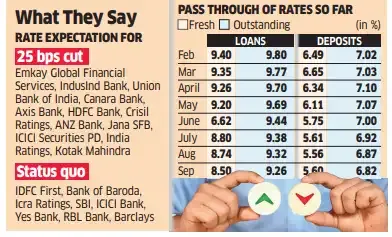
The central bank has cut the rate by 100 bps (1 percentage point) to 5.50% since February and has maintained a pause since August. Against this, rates on outstanding loans have dropped 54 bps, while those on outstanding deposits have fallen 20 bps. Rates on fresh loans are down 100 bps and fresh deposits by 89 bps.
Notably, two institutions that previously projected a rate cut have revised their expectations.
Barclays and Icra Ratings made the revision following the release of the latest GDP data and now see RBI maintaining the status quo.
On the other side are economists who point to lower nominal GDP growth, elevated tariff-related risks, the possibility of inflation coming in below RBI’s projections in the next fiscal year and a prevailing sentiment of “if not now, then when.”
“We no longer expect the RBI MPC to cut the policy rate in the upcoming meeting,” said Aastha Gudwani, India chief economist at Barclays Bank. “Friday's second quarter FY26 real GDP growth surpassed our and RBI's expectations. We acknowledge that growth has peaked and expect second half FY26 growth to slow versus the first half.”
Gudwani had previously called for a rate cut, citing inflation was “too low to ignore.”
Against the RBI projection of 6.8% growth in July-September, the Indian economy grew 8.2%, the fastest in the previous six quarters. Nominal GDP grew at 8.7% in the second quarter, versus 8.8% the year before.
Along with this, retail inflation slowed to 0.25% in October. That’s the lowest since the current series began in 2015.
RBI has forecast 2.6% inflation for FY26, 4% in the fourth quarter of FY26 and 4.5% in the first quarter of FY27. The central bank revised its full year FY26 inflation estimate downwards to 2.6%, from 4.2% in February.
“FY26 estimated inflation is now tracking less than 2%, implying risk of a further undershoot of about 50-60 basis points to RBI’s FY26 inflation forecast,” said Madhavi Arora, chief economist at Emkay Global Financial Services. “This could support the case for a December rate cut. However, it's a close call.”
Most economists anticipating a rate cut have expressed a similar view.
“The low nominal growth numbers at 8.7% in the second quarter of FY26 do signal that there is need for caution,” said Sakshi Gupta, principal economist at HDFC Bank. “This year, the story has been about growth overshooting and inflation undershooting. Therefore, the upcoming RBI rate decision remains a close call.” She sees space for a 25-bps rate cut.