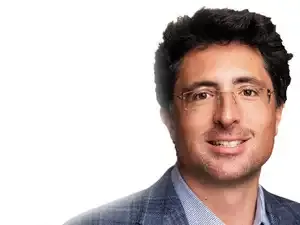
Niccolo De Masi, CEO, IonQ CEO
Davos: Quantum computing is advancing way faster than governments and companies expect and could reach the point where it can break today's most widely used encryption standards within the next three years, according to Niccolo De Masi, chairman and chief executive of US-based quantum computing lab IonQ.
"We're driving what's called Q-day earlier and earlier on the roadmap," De Masi said, referring to the moment when a quantum computer becomes powerful enough to crack RSA-2048 encryption using Shor's algorithm. "People assume the Q-day was happening in 2040...I think it is going to arrive like a freight train by the end of the current US administration," De Masi told ET on the sidelines of the World Economic Forum at Davos on Monday.
But this also presents serious implications for global security. "This is the space race meets the Manhattan Project of our generation," he said. During World War II, the Manhattan project led by scientist J. Oppenheimer conducted the first nuclear tests and created two atomic bombs which led to the bombing of Hiroshima and Nagasaki.
"And it may not have bodies piling up in the street, because cybercrime never does that directly, but this is a ten trillion-dollar economic impact. If our nation does not prevail in the space race and Manhattan Project of our time, and someone else does, who's not a friend of ours, it's not gonna be good for the economy, and for every other nation," he said.
De Masi explained that the ability to break encryption poses risks not just to blockchains, but to banking systems, communications networks and national infrastructure.
The potential economic impact of unsecured quantum breakthroughs is estimated to be $10 trillion, he said, adding that nations are already realising they are "half-a-decade to a decade behind" in preparing quantum-safe defences. As a result, he expects a surge in spending on post-quantum cryptography and quantum key distribution to protect critical infrastructure.
The NYSE-listed company with a market value of $18 billion has already demonstrated the "quantum advantage" three times with other public company partners, including in drug discovery, where it compressed a month of classical computing work into 24-36 hours using quantum systems. De Masi said the company's newest machines are now more than 200 million times more powerful than those used in last year's demonstrations.
Unlike classical computing, where performance gains follow Moore's Law, IonQ's systems scale exponentially with the addition of each logical qubit, he said. "We double every time we add a logical qubit. That means the compute space grows as the exponent of the number of logical qubits," De Masi said.
IonQ's roadmap shows logical qubits increasing from 36 eighteen months ago to 256 by the end of this year, 10,000 next year, and 100,000 the year after, he said. "That puts you into computational power that is unfathomably large," he said, adding that quantum computing will "arrive like a freight train."
While much of today's tech investment is focused on artificial intelligence, De Masi argued that quantum computing will ultimately reshape AI itself by reducing energy consumption and enabling new forms of intelligence. "It can't be that the future of humanity is five or ten percent of the energy grid going to data centres and then rising to fifty or ninety percent," he said.
He predicted that strong AI would make a comeback when paired with quantum systems, calling the human brain "a biological quantum computer" that operates on just five watts of power.
"The future will be CPUs, GPUs and QPUs working together," De Masi said. "Quantum is coming faster than people think, and the world needs to prepare for it."
"We're driving what's called Q-day earlier and earlier on the roadmap," De Masi said, referring to the moment when a quantum computer becomes powerful enough to crack RSA-2048 encryption using Shor's algorithm. "People assume the Q-day was happening in 2040...I think it is going to arrive like a freight train by the end of the current US administration," De Masi told ET on the sidelines of the World Economic Forum at Davos on Monday.
But this also presents serious implications for global security. "This is the space race meets the Manhattan Project of our generation," he said. During World War II, the Manhattan project led by scientist J. Oppenheimer conducted the first nuclear tests and created two atomic bombs which led to the bombing of Hiroshima and Nagasaki.
"And it may not have bodies piling up in the street, because cybercrime never does that directly, but this is a ten trillion-dollar economic impact. If our nation does not prevail in the space race and Manhattan Project of our time, and someone else does, who's not a friend of ours, it's not gonna be good for the economy, and for every other nation," he said.
De Masi explained that the ability to break encryption poses risks not just to blockchains, but to banking systems, communications networks and national infrastructure.
The potential economic impact of unsecured quantum breakthroughs is estimated to be $10 trillion, he said, adding that nations are already realising they are "half-a-decade to a decade behind" in preparing quantum-safe defences. As a result, he expects a surge in spending on post-quantum cryptography and quantum key distribution to protect critical infrastructure.
The NYSE-listed company with a market value of $18 billion has already demonstrated the "quantum advantage" three times with other public company partners, including in drug discovery, where it compressed a month of classical computing work into 24-36 hours using quantum systems. De Masi said the company's newest machines are now more than 200 million times more powerful than those used in last year's demonstrations.
Unlike classical computing, where performance gains follow Moore's Law, IonQ's systems scale exponentially with the addition of each logical qubit, he said. "We double every time we add a logical qubit. That means the compute space grows as the exponent of the number of logical qubits," De Masi said.
IonQ's roadmap shows logical qubits increasing from 36 eighteen months ago to 256 by the end of this year, 10,000 next year, and 100,000 the year after, he said. "That puts you into computational power that is unfathomably large," he said, adding that quantum computing will "arrive like a freight train."
While much of today's tech investment is focused on artificial intelligence, De Masi argued that quantum computing will ultimately reshape AI itself by reducing energy consumption and enabling new forms of intelligence. "It can't be that the future of humanity is five or ten percent of the energy grid going to data centres and then rising to fifty or ninety percent," he said.
He predicted that strong AI would make a comeback when paired with quantum systems, calling the human brain "a biological quantum computer" that operates on just five watts of power.
"The future will be CPUs, GPUs and QPUs working together," De Masi said. "Quantum is coming faster than people think, and the world needs to prepare for it."