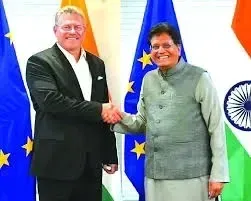
India-EU: India’s proposed Free Trade Agreement with the European Union has triggered a fresh political exchange, with Union Commerce and Industry Minister Piyush Goyal firmly pushing back against criticism from Congress leader Jairam Ramesh. The minister described the objections as politically motivated and argued that the agreement represents a balanced and mutually beneficial partnership between India and the EU, rather than an overpromised deal.
Responding to the remarks made by Jairam Ramesh, Goyal said it was ironic to see objections from leaders who, according to him, failed to take decisive action when they previously held power. He maintained that prolonged indecision in the past had cost India employment opportunities, income growth, and industrial expansion. Goyal added that voters had repeatedly expressed dissatisfaction with such inaction over the years.
In a social media statement, the minister said India had paid a tangible economic price for delays in trade and reform decisions, suggesting that the current government was determined not to repeat those mistakes.
Addressing claims that the India-EU FTA has been excessively promoted, Goyal highlighted the economic scale involved. He pointed out that the agreement brings together economies with a combined gross domestic product of around USD 25 trillion and total global trade exceeding USD 11 trillion. According to him, the pact also opens access to a market of nearly two billion people.
The minister stressed that a significant portion of India’s labour-intensive exports would benefit from immediate tariff reductions once the agreement takes effect. He argued that these outcomes demonstrate tangible economic value rather than exaggerated expectations.
Jairam Ramesh, in his criticism, raised multiple concerns related to the agreement’s potential impact. These included worries over the European Union’s Carbon Border Adjustment Mechanism, declining exports of aluminium and steel, strict health and safety regulations, intellectual property provisions, access to services, and possible risks to India’s automobile and electric vehicle sectors. He also questioned future prospects for refined fuel exports, particularly those linked to Russian crude sources.
On the issue of CBAM, Goyal said the government has actively taken up the interests of Indian exporters in sectors such as steel and aluminium. He stated that India is working through structured dialogue and cooperation to address climate-related trade measures, rather than adopting confrontational or rigid negotiating positions.
The minister emphasized that India has identified practical pathways to manage these complex challenges while protecting domestic industry and maintaining engagement with European partners.
Goyal also responded to concerns surrounding the automobile and EV industries. He explained that India’s offer to the EU is designed around quotas, premium vehicle segments, and a phased implementation plan, including a five-year transition period for electric vehicles. According to him, this structure is intended to strengthen domestic manufacturing under the Make in India initiative.
He added that allowing liberalised imports of completely knocked down vehicle kits could encourage European manufacturers to establish assembly units in India. Over time, this could lead to higher localisation, advanced manufacturing capabilities, improved safety standards, and access to better technology.
Addressing fears that the agreement could restrict India’s regulatory freedom, Goyal said all countries retain the sovereign right to regulate in the interest of public health and safety. He noted that the agreement includes safeguards to ensure such regulations are not misused as disguised trade barriers.
On intellectual property rights, he clarified that the commitments align with existing WTO rules under TRIPS. He highlighted continued flexibility for public health, support for technology transfer, recognition of India’s traditional digital knowledge library, and the protection of India’s current data exclusivity framework.
Goyal concluded by stating that concerns over refined fuel exports stem from factors unrelated to the agreement itself. He described the India-EU FTA as a long-term strategic partnership built on trust, cooperation, and mutual respect, aimed at supporting sustained economic growth for both sides.