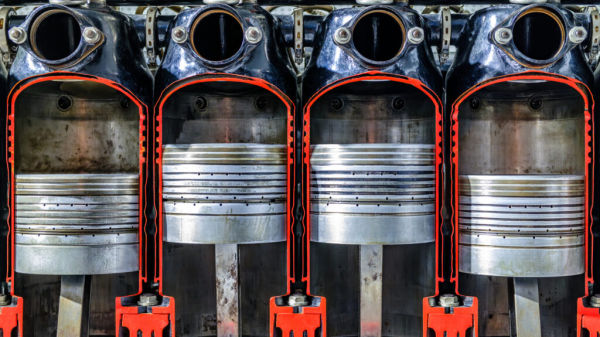
There’s a common phrase in the automotive sphere: “There’s no replacement for displacement.” But what does that mean, exactly? Well, an engine’s displacement is measured by the volume of the collective combustion chambers — in a V6, for instance, it’s all six cylinders’ combined volume. In mathematics, we get the volume of a cylinder by two main factors: how wide is it, and how tall is it? Translated into engine terms, that’s bore and stroke.
In a phrase, an engine’s bore is how wide the cylinder is, and the stroke is how far the piston travels up and down. Combine the two to get that cylinder’s volume, and multiply it by the cylinder count to get the engine’s total displacement. Sounds simple enough, right? Yes and no — there’s actually a substantial difference in how bore and stroke affects an engine’s power output.
The inside of an engine is a complex, violent place, with the forces of combustion pushing down on a metal beam with tremendous pressure. This creates momentum; the piston then imparts torque on the crankshaft, transitioning the up-down motion into rotational motion and making power. It’s fairly intuitive that the wider the piston and the further it travels, the more power it generates — bigger engines produce bigger power, after all. But there is a lot of underlying physics at play here, which we’ll get into in this article. For simplicity’s sake, you can take away that an engine with a wider bore has more horsepower than torque; and an engine with a longer stroke has more torque than horsepower. How exactly does that work, though? Let’s dive into it.
How bore diameter affects horsepower
As mentioned before, an engine’s bore diameter is how wide the cylinder (and the piston itself) is. The wider the bore, the more real estate is available for the valvetrain. The bigger the valves, the more air can be pushed into the combustion chamber, ignited, and extracted via the exhaust. An engine with a larger bore vs. stroke is called an oversquare engine, as opposed to a square one (with equal bore and stroke, making a square-shaped combustion chamber when viewed sideways-on).
As a rule of thumb, an oversquare combustion chamber produces more high-end horsepower and less low-end torque. These are your high-revving powertrains — engines like those used in Formula 1, sport bikes, and many performance and racing vehicles. A simple way to remember the relationship between torque and horsepower is that torque is how easily a wheel spins whereas horsepower is how quickly it can spin. This is because of the principle of leverage; a longer rod throw means the piston travels a greater distance from the top to bottom. Therefore, the force it exerts on the crankshaft is greater — thus, more torque. Oversquare engines lack this velocity, but make up for it in an optimal air quantity for high RPMs.
Oversquare engines’ bigger valvetrains mean a greater quantity of air can be inhaled at high RPMs when it matters most — think of opening your mouth wide to gulp in air versus using a straw. This means that the engines produce their peak horsepower at high RPM ranges thanks to less restrictive airflow, albeit with the trade-off that they have less leverage on the crankshaft at low RPMs.
How stroke length affects torque
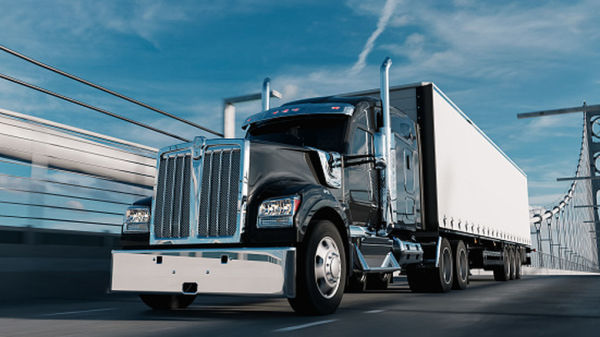
The opposite of an engine with a wider bore is, naturally, an engine with a longer stroke, called an undersquare engine. The pros and cons of this configuration directly mirror those of the oversquare engine, producing more torque at low RPMs and achieving their peak engine horsepower earlier in the power curve. As a result, typical undersquare engines excel at hauling and towing, with common examples being truck and marine diesels.
The reason why these engines produce so much torque is due to the leverage principle we talked about earlier. The more distance the piston covers for a given rotation, the faster that piston travels at any given RPM. Thus, the higher the air’s velocity — it sucks in air faster, like pulling a syringe plunger really quickly. However, that air bottlenecks quickly because of the smaller valvetrain, as undersquare engines have less room for valves because they’re narrower. This means that an undersquare engine lacks efficiency at high RPMs, where it can’t suck in air fast enough to maintain combustion.
Another point against this engine type is that the faster the piston travels, the more momentum it exerts. Put simply, throwing a massive metal weight around at extreme speeds is an excellent way to render an internal combustion engine into an external combustion engine. Thus, to avoid breaking, undersquare engines have lower redlines. That’s why extreme oversquare engines like old F1 powertrains can rev up to 20,000 RPM; conversely, large marine diesels operate at extremely low RPM, far less than even the idle RPM speed of the average passenger car.