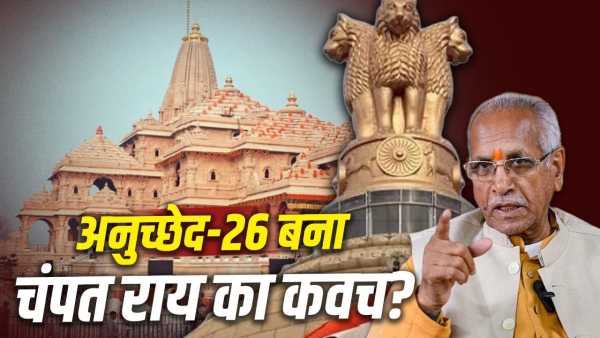
On the basis of the SIT report in the case of theft of Ram Mandir temple offerings, FIR has been lodged against 8 people and they have been arrested. However, the role of officials associated with Shri Ram Janmabhoomi Teerth Kshetra Trust in this matter is also under question. The management role of Champat Rai, the most influential person and General Secretary of the Trust, is also under investigation. At present, he has resigned from his post.
This question is constantly being raised as to what is the reason due to which neither an FIR has been registered against Champat Rai nor he has been arrested. However, Vinay Katiyar has definitely said that he has spoken to Prime Minister Narendra Modi. Champat Rai may also be arrested.
In social media and political debates, Article 26 is being presented as a kind of constitutional shield for them. It is being said that this article is the biggest reason behind Champat Rai not being arrested. But before knowing whether this is actually happening because of this, it is important to know what Article 26 is and what kind of rights it gives.
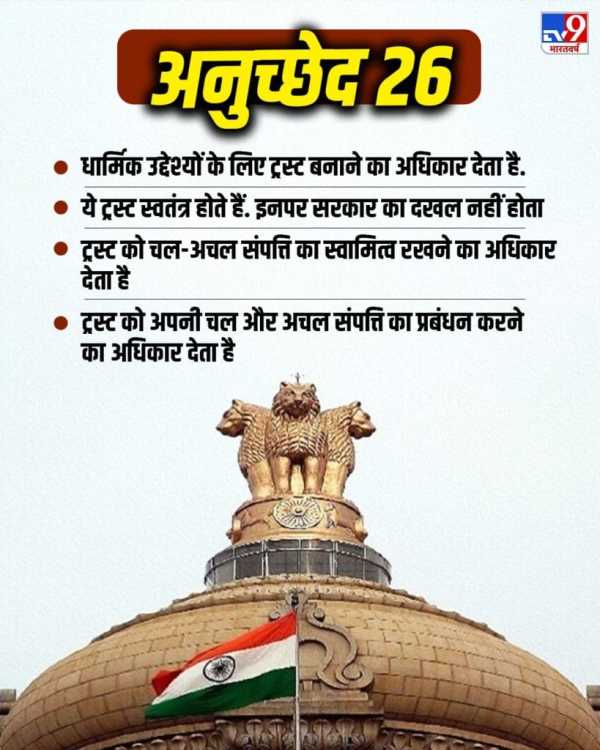
According to the Indian Constitution, Article 26 gives religious sects and religious institutions the right to form trusts for the management of their religious affairs. It also gives the trust the right to acquire and manage property for itself. Article 26 is divided into 4 parts.
There is no mention anywhere in Article 26 that any particular person associated with the Trust should be given immunity or protection in criminal cases. Nor does it give anyone the right to avoid FIR and arrest. This article allows religious institutions to exercise administrative and religious rights. If any person associated with the trust is accused of any crime, then action is also taken against him under the Indian Penal Code.
Now the question arises that what is the role of Article 26 in the FIR and arrest against Champat Rai. The answer lies in the definition of Article 26 (b). Actually, it gives the trust created for religious purposes the right to manage its affairs.
The state has no right to interfere in their affairs. Even in the Ram temple offering theft case, no criminal case is being made against Champat Rai. Nor has any evidence of financial fraud against him come to light so far. The only allegations against them are negligence in management, taking action on which is beyond the jurisdiction of the state and the police. Till now only the Trust has the right to take action against Champat Rai. That too when the trust has two-thirds majority of its members.
1. The trust itself will decide how much administrative interference there should be within the trust. Till now, SIT investigation and FIR have been registered only on the recommendation of the Trust. This means that whatever legal action has been taken so far, it has been taken only at the behest of the Trust.
2. He himself will decide how the trust will take the decision. There is no official bylaw of Ram temple. Once there was talk of two-thirds only on the selection of the idol. After that there was no internal discussion.
3. In the year 2014, in the Tamil Nadu vs Subramaniam Swamy case, the Supreme Court said that the government can temporarily take over the management of the temple citing financial irregularities, but later it will have to hand it back to the Trust.
In the year 2020, the Supreme Court, while hearing the case of a public trust registered under the Madhya Pradesh Public Trust Act (1951 Act) giving consent to sell its five immovable properties, had said that the principle of autonomy and democratic decision making cannot be underestimated.
Any institution which is self-governing, such as a trust, cannot be subjected to the control of the state. As long as his decisions are well-informed, and based on relevant considerations