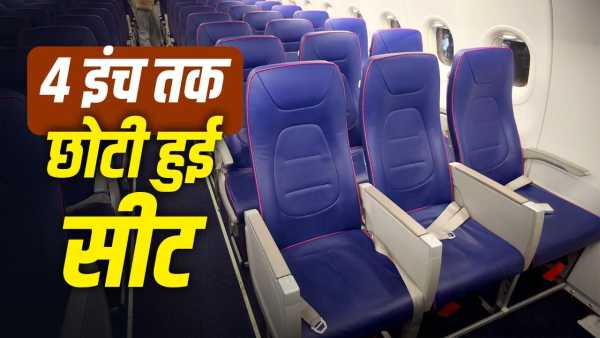
If you also feel that spreading your legs on the economy class seat of an airplane has now become more difficult than before, then it is not just your misconception. Over the past four decades, airlines around the world have slowly but steadily reduced passenger seating capacity. The surprising thing is that during this period the average height and thickness of humans has also increased. The result is that today a common passenger has to travel in much less space in the same flight than before. Aviation industry figures and airlines' seat maps show that this shrinkage is not just a matter of comfort, but has now become a health and safety issue. Let us tell you the economy of seats in this story. They tell us about how much she has changed and also understand the concept of what will have to be done while standing and traveling in the future.
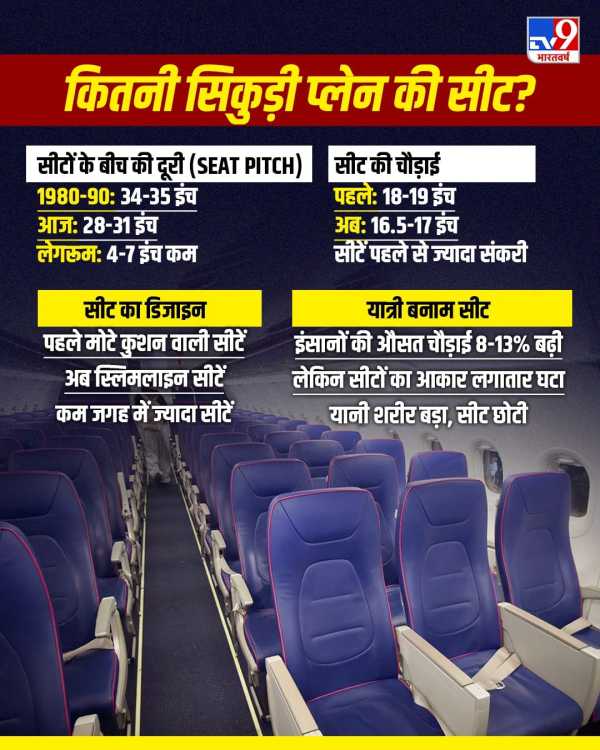
In the 1980-90s, the seat pitch i.e. the distance between two seats in economy class was usually 34-35 inches. Today, in most of the big airlines, this gap has come down to 30-31 inches, while in low-cost airlines around the world, including India, this gap has come down to 28-29 inches. That means on an average every passenger is getting 4 to 7 inches less legroom than before. The seat width has also reduced from 18-19 inches to around 16.5-17 inches during this period. Seats once had thick cushions, but now slimline designs have become common, allowing airlines to fit more seats in the same space. Interesting thing is that in the period when the seats have shrunk, the human body has increased in the same period. According to analyzes published in science journals, the average width of humans while sitting has increased by about 8 to 13 percent in the last four decades. That means on one side the body is getting bigger and on the other side the seating space is getting smaller.
This change is not limited to seats only, but is also clearly visible in the number of seats inside the planes. Earlier there were 120-130 seats in Boeing 737, but today airlines are installing 180-190 seats in the same aircraft. Similarly, where earlier there was a maximum of 150 seats in Airbus A320, now this figure has reached 180-186. Obviously, the structure of the plane is almost the same, but the number of passengers crammed into it has increased considerably.
Today, getting more legroom or a favorite seat is no longer a free facility, but has become a means of additional income. For XL or extra-legroom seats in domestic flights in India, passengers have to pay extra Rs 500 to Rs 2 thousand. Whereas in international flights, depending on the route and demand, many airlines charge Rs 3 to 10 thousand for this. Aviation experts believe that this model has proved to be extremely beneficial for the airlines, because by keeping the base price of the ticket low, the airlines attract customers and later earn additional income in the name of comfort.
The biggest reason for the small number of seats is the mathematics of profit. Since air travel has become cheaper and competition has increased, the entire focus of airlines has been on carrying more passengers in less space. In India itself, there has been a tremendous jump in the number of air passengers in the last decade, this number has almost tripled by 2025-26 as compared to 2015-16, i.e. an increase of more than 200 percent. Both aircraft manufacturing companies and airlines believe that by installing light and thin seats, one or two extra rows can be added to the aircraft, which can lead to additional earnings of crores of rupees annually. Many experts have also warned that the continuous shrinking of seats and the planes being filled to full capacity can also make the process of evacuating passengers from the plane difficult in case of emergency.
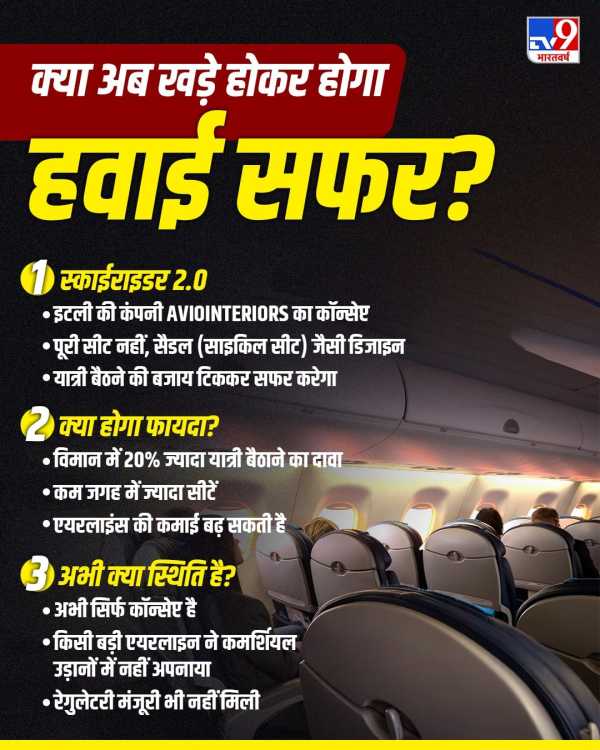
This exercise of shrinking seats has now gone one step further. Italian company Aviointeriors has developed a standing-style seat called Skyrider 2.0, in which the passenger travels resting on a saddle-like structure instead of sitting completely. The company claims that by adopting this design, about 20 percent more passengers can be accommodated in the aircraft. Although no major airline has yet included it commercially in its service, but aviation experts say that if cost and profit pressures continue to increase at this pace, then such a concept can be tried on some budget routes in the coming years.
Overall, air travel may have become more accessible and cheaper than ever before, but passengers have to pay the price by reducing their personal space. The question now is not whether seats will shrink further or not, but what steps passengers and regulators will take next, because as seats keep getting smaller, people's problems will obviously keep increasing.