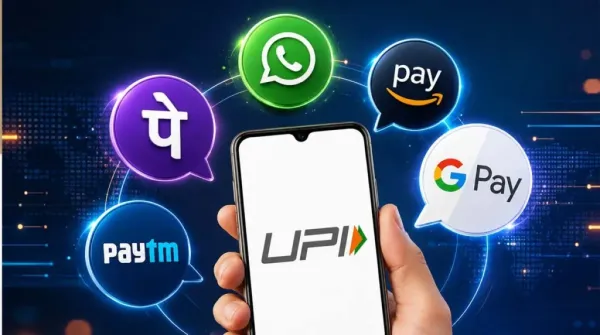
In India today, the use of UPI has become an integral part of our lives, from sipping morning tea to paying for groceries and vegetables, and at every small and big place. Therefore, whenever there’s even the slightest news of charges or fees being levied on UPI transactions, it raises concerns among ordinary citizens. Following the recent introduction of a new bill in Parliament, the debate has once again intensified as to whether making online digital payments will cost us money. Amidst the uproar surrounding this issue, Reserve Bank of India (RBI) Governor Sanjay Malhotra issued a significant statement on August 5th, attempting to clarify the situation to a large extent.
The biggest and most important question is whether the average consumer will now have to pay out of pocket to use UPI? At present, the answer to this question is a clear ‘no.’ So far, no new charges have been imposed on ordinary consumers, merchants, or any other normal UPI transactions. In his monetary policy press conference, RBI Governor Sanjay Malhotra made it clear that it’s too early to determine who will ultimately bear the financial burden if the Merchant Discount Rate (MDR) is implemented.
He emphasized that maintaining such a vast payment network involves significant costs, which must be paid for by someone. Often, customers indirectly bear the cost of this infrastructure, even if they don’t directly pay transaction fees.
Media reports and sources suggest that the government is considering imposing an MDR of less than 0.5 percent on commercial UPI payments exceeding ₹2,000, i.e., payments made to merchants. However, the silver lining is that private person-to-person (P2P) money transfers will be completely excluded from this proposed new framework.
Data shows that while transactions above ₹2,000 represent only 5% of total UPI payments, they represent approximately 65% of the total value. This rule will not impact small, everyday payments. However, the bill introduced in Parliament does not yet officially mention any fixed rate or this ₹2,000 limit.
Finance Minister Nirmala Sitharaman introduced the “Taxation and Other Laws (Amendment) Bill, 2026” on August 4th. This new bill will significantly change Section 10A of the Payment and Settlement Systems Act, 2007. This simply means that the central government will now have the legal authority to determine which electronic payment modes will be completely free and which ones may be subject to government or bank charges. Until this bill becomes law and new guidelines are issued by the government, the “zero-MDR” rule that has been in place since January 2020 for UPI and RuPay debit cards will remain in effect.
The government initially completely eliminated all charges on UPI to rapidly promote digital payments in the country. However, the banks and payment companies that run this system day and night have long demanded a stable revenue model. Their main argument is that modern technology, robust cybersecurity, and managing this vast network incur significant costs.
A Parliamentary Standing Committee report released in March 2026 also confirmed that government incentives are insufficient to cover these industry expenses. In July alone, 23.66 billion transactions worth ₹29.88 lakh crore were recorded through UPI. A sustainable financial framework is now being sought to ensure the secure and uninterrupted operation of such a vast and sensitive network.