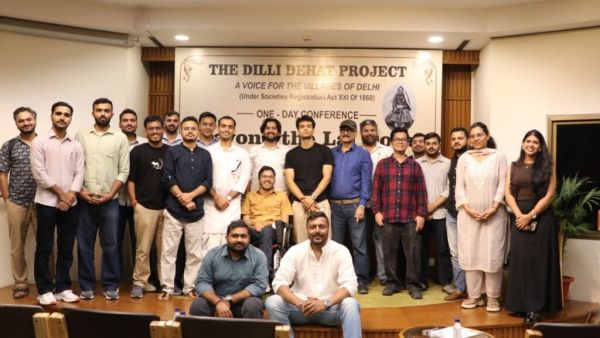
'Lal Dora' is once again in the news in the capital Delhi. CM Rekha Gupta has ordered to prepare digital records of lands and houses of Lal Dora and populated villages in Delhi. It was organized in 'India International Center' regarding this. What is Lal Dora in the program? In this, the revenue limit of the villages and the status of the historical villages of Delhi within the modern metropolis were discussed.
In the program 'Beyond the Lal Dora: Land, Legitimacy and the Vanishing Commons in Delhi's Urban Villages', intellectuals reflected on the changing situation of Delhi's villages. The speakers included in this presented the land, shared resources, language spoken here, means of livelihood and the culture of living together in the community of urban villages of Delhi.
In the Delhi Dehat Project, the history of more than 300 villages of Delhi, their ecology and the life experiences of the people have been compiled through archival research, oral history, field study, public writing and community documentation. Of course, the Rekha Gupta government is adding Lal Dora to the digital records, but in this program dialogue and talks were held about these villages.
Delhi Dehat Project is founded by Puneet Singh Singhal and co-founders Parth Shokeen and Gagandeep Singh. Kumkum Jayaram, Bindu Romi Garjur and Akshay Kumar provided support to research, documentation, systematic and planning of villages in the programme. The program was coordinated by Rajvardhan Singh.
It was told in the conference that the India International Center where the program is being held today was once in the historical Kharaipur village of Delhi. It was told that today's modern and systematically planned Delhi stands on the geography of old villages.
Senior lawyer Naveen R. Talking about the complex legal history of village land in Delhi, Nath said that decades-old disputes are still unresolved. There are also cases where questions to consolidation and ownership have been going on for generations. He emphasizes that property relations in older villages were not always developed on the basis of the kind of formal documents that today's planning system requires. In many cases the distribution, transactions and ownership understandings of land and built space were negotiated orally by the people rather than by any one formal urban authority.
The project looks at this legal ambiguity within a wider history of long-standing exclusion from planning. When fires, building collapses or other tragedies occur in the villages of Delhi, the villages themselves are often blamed. As if density, informality or so-called 'untimelyness' are the sole reason for these dangers.
The reality is much more complex than this. Many of these conditions developed over decades of a planning environment where rules were unclear, infrastructure was weak, law enforcement was selective, and institutional neglect persisted. With the expansion of the city, the villages got incorporated into Delhi economically and geographically, but their inclusion in the city administration and planning system was not done with the same clarity.
Therefore, where unsafe construction or rule violations have occurred, accountability is necessary. But villages cannot be made convenient villains for threats that the city's own administrative failures have also played a role in creating. The question of Lal Dora is not just a question of exemption from rules but also of what are the consequences when a settlement is left oscillating between rural and urban settings for decades, without any clear institutional transition.