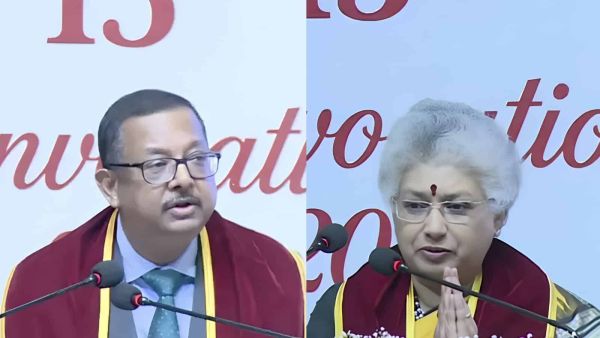
New Delhi: Supreme Court judges Justice Ujjal Bhuyan and Justice BV Nagarathna have both used addresses at the National Law University, Delhi, to weigh in on the fallout from the recent row over student objections to Chief Justice of India (CJI) Surya Kant’s participation at Hyderabad’s NALSAR University of Law convocation.
Justice Bhuyan, addressing the LLM convocation, said students cannot be threatened with punitive action simply for holding views that differ from those in authority, calling such conduct “unconstitutional and an abuse of power.”
“In a democracy, the right to question is not an act of defiance. It is an essential expression of citizenship, liberty and constitutional responsibility,” he said.

“So when students express a different point of view, when students ask questions, they cannot be threatened. They cannot be threatened with punitive action. That is unconstitutional. That is misuse of power and office,” he added.
Justice Nagarathna, speaking at the university’s 13th convocation on August 29, said bar councils needed to reflect on their own conduct. “The Bar Councils, whether the central or the states, must introspect their role and importance in upholding professional ethics, morality and professional competence. When a Bar Council does not earn the respect of its members, it is not a good sign for the legal profession,” she said.
Her remarks follow the Bar Council of India’s directive, issued by chairman Manan Kumar Mishra, asking state bar councils not to enrol NALSAR Hyderabad’s graduating 2026 batch as advocates after the students objected to the CJI being invited as chief guest at their convocation, citing his remarks on violence during student protests.
The BCI later withdrew the letter after a backlash and the Supreme Court questioned its action, directing that no punitive steps be taken against students or faculty.
The controversy then spread to the National Law School of India University in Bengaluru, where outgoing students opposed the participation of both the CJI and the BCI chairman. NLSIU eventually cancelled its convocation, citing “unavoidable circumstances” and said degrees would be awarded in absentia.
Justice Nagarathna said the Bar in India must “rise and speak in a singular voice” on sustaining the country’s justice delivery system, pointing to pendency, delays, rising costs and uncertainty.
“The independence of the bar is not an entitlement given to lawyers for their own benefit. It exists because a constitutional democracy requires a body of professionals who can advise, argue, challenge and represent without having to ask the permission of the state, the market or even their own clients before doing so,” she said.
Lapses by the Bar would have a deep impact on political and civic life, she cautioned, urging lawyers to treat work for clients as public service or risk losing their relevance. “A profession is not an occupation or a trade but an office of trust and cannot be reduced to a person who sells legal knowledge by the hour,” she said, telling graduates they were leaving as “Officers of the Court and Stewards of the Constitution.”
Justice Bhuyan, for his part, said constitutional democracy requires neither agreement nor uniformity. “Our Constitution does not seek uniformity of thought. It creates a framework in which people with different beliefs, opinions and convictions can live with equal dignity and participate in a common democratic life,” he said.
He was sharply critical of intolerance, calling it a form of violence in itself. “An intolerant mind, by its very nature, is at odds with the spirit of the Constitution. It is a manifestation of another form of violence. India is the land of Buddha and Gandhi,” he said, adding that intolerance erodes the constitutional framework when dissent stops being treated as legitimate difference and becomes something to be silenced or punished.
The culture of a democratic society respecting liberty and difference had to begin in universities, he said, describing a university as a space where an idea is not accepted merely because it is familiar, and where students do not hesitate to ask difficult questions because the answers may be uncomfortable.