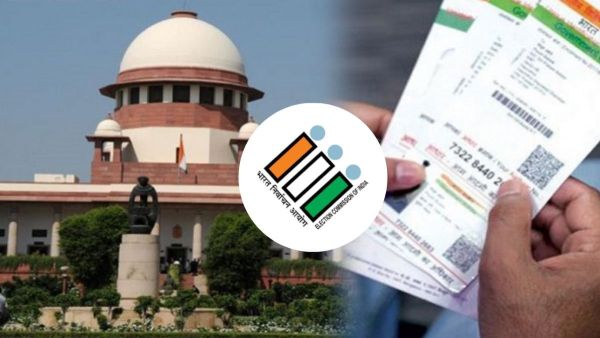
During the hearing on Wednesday, the Supreme Court expressed strong objection to the argument that Aadhaar card should be removed from the documents that voters are allowed to use for identity verification during the Special Intensive Revision (SIR) process being conducted for the voter list, because these can be easily faked and can be obtained from private agencies.
Justice Joymalya Bagchi, who was part of the division bench led by Chief Justice of India (CJI) Surya Kant, asked senior advocate Vijay Hansaria, do you know that passports are also outsourced to a private agency under the supervision of the Government of India? These private service centers (through which Aadhaar enrollment and updates can be done) work under statutory authorities or the government itself. Aadhaar is a public document. Any document can be made fake. Even passports can be forged, the private centers are performing a public duty while issuing Aadhaar.
Passport is one of the 11 original documents which were allowed by the Election Commission in its order announcing the SIR process on June 24 last year.
Arguing in the court on behalf of petitioner-lawyer Ashwini Kumar Upadhyay, Hansaria said the court should consider its September 8, 2025 order to include Aadhaar as the 12th 'indicative' document for verification and identity proof. This order was given by the court during the ongoing SIR process in Bihar.
He said that about 5.72 lakh private common service centers do Aadhaar enrollment or update it, and any person with Class 10 qualification, basic computer knowledge and a biometric machine can run such a centre.
Citing the Aadhaar Act 2016 (Targeted Delivery of Financial and Other Subsidies, Benefits and Services), Hansaria said that this document is not meant to verify citizenship or identity, but is only a document designed to promote “good governance, efficient, transparent and targeted delivery of subsidies, benefits and services”. He also argued that Section 2(v) of the Aadhaar Act 2016 defines 'resident' as any person, including a foreigner, who has resided in India for at least 182 days immediately preceding the date of application for Aadhaar.
Senior advocate Hansaria said, “Therefore, Aadhaar cannot prove someone’s citizenship.” Citing Section 9 of the Act, he said that this provision clearly states that the Aadhaar number cannot be used as proof of citizenship or residence.
During the hearing, Justice Bagchi, while responding to the arguments, said, "Aadhaar is a recognized document of identity. We have never said that Aadhaar can be used as the basis of citizenship. We have always said that the Election Commission can verify Aadhaar."